Qodosen DX-286
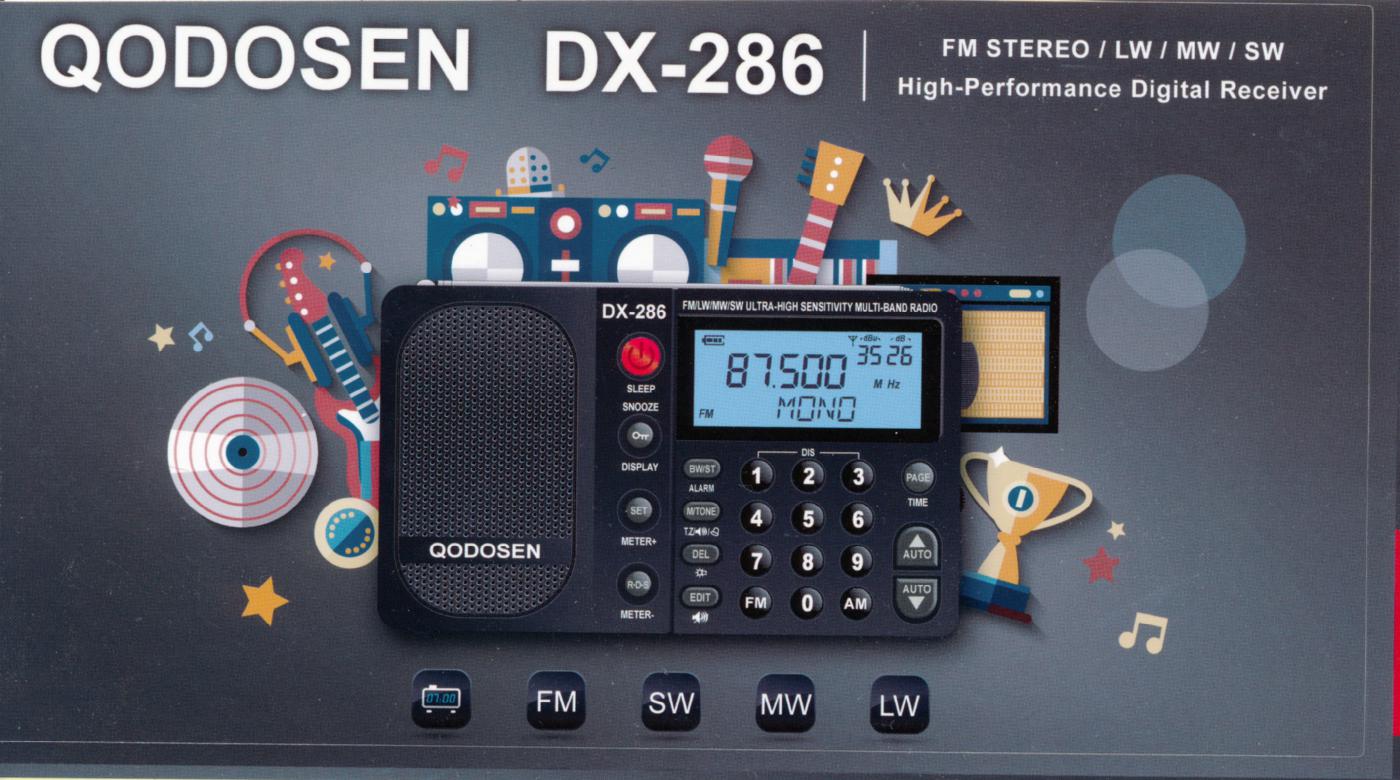
“That's a pretty nice little toolbox,” my wife remarked as I took the Qodosen DX-286 out of the box. And indeed, this sleek world receiver isn't just very well packaged, but also perfectly protected against damage during transport: it comes in an elegantly designed case with plenty of room for the well-packed radio and all its accessories.
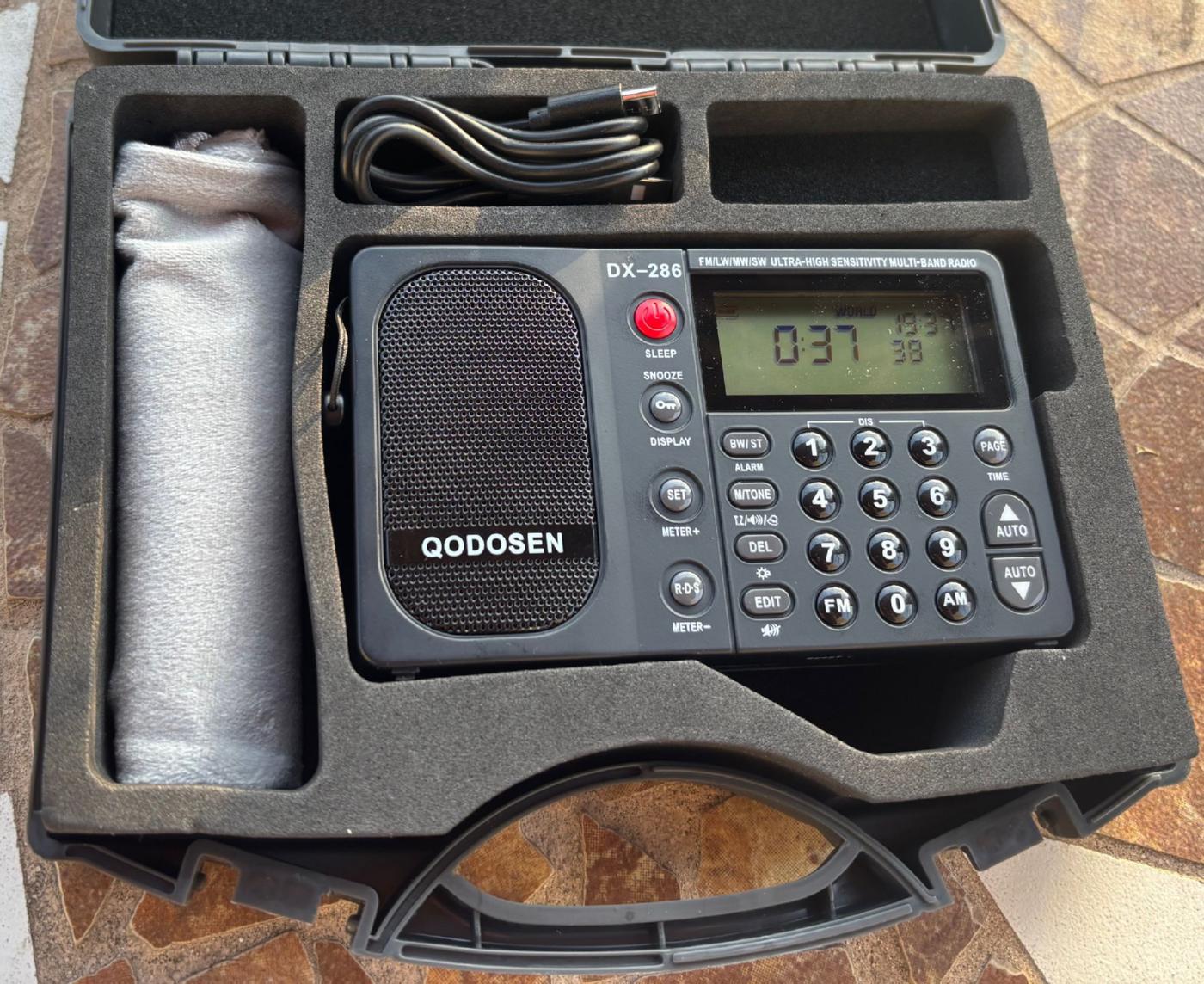
Well packed
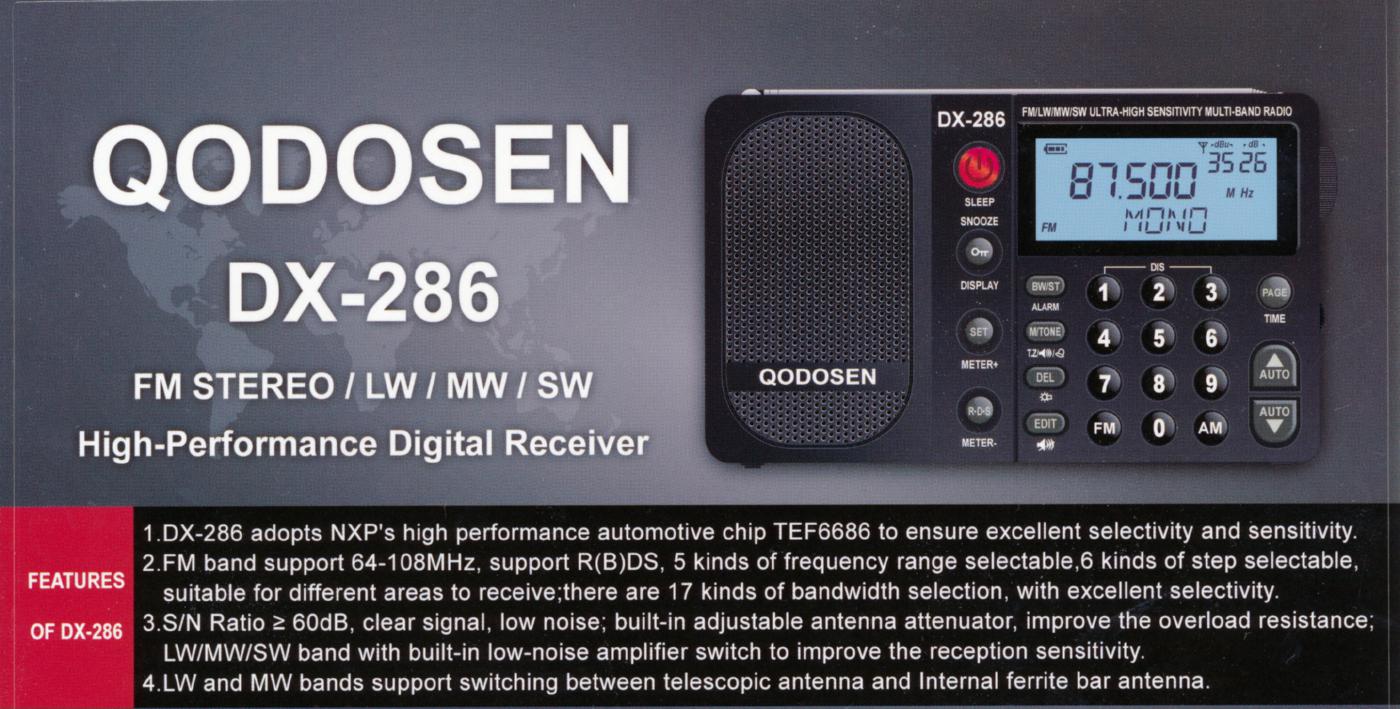
The package includes a charging cable, the appropriate battery, and a carrying case that is as soft and fluffy as it is practical, designed to protect the device from scratches. The case also contains two stickers—one of them brightly colored, the other listing the world receiver’s key features.
Small—black—strong! That’s how Italian espresso is usually described. But these attributes also apply to the latest development from Qodosen. The truly amazing features of the DX-286 will be discussed below.
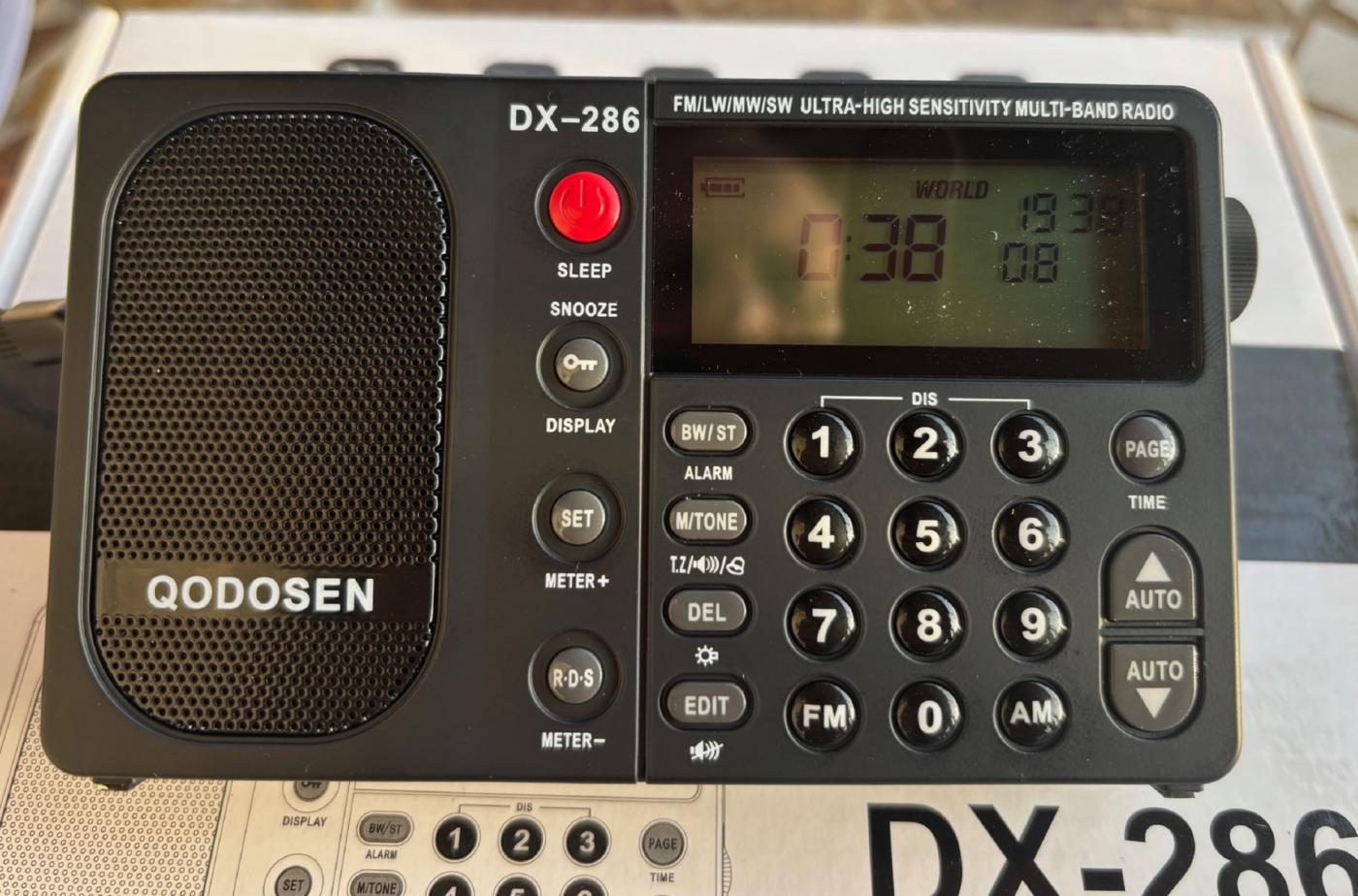
Weighing just under 250 grams, this little all-rounder from southern China comes complete with a rechargeable and replaceable battery. Measuring 12 x 7 x 2.5 cm, it definitely belongs in the category of “the world’s smallest world receiver.” Its status as one of the most high-performance radios is ensured, among other things, by the built-in and carefully configured TEF6686 chip, which has also delivered impressive results in radios from other manufacturers.
Particularly user-friendly features include the clear display, direct frequency entry, and, last but not least, the fold-out tab on the back, which allows the device to be positioned comfortably.
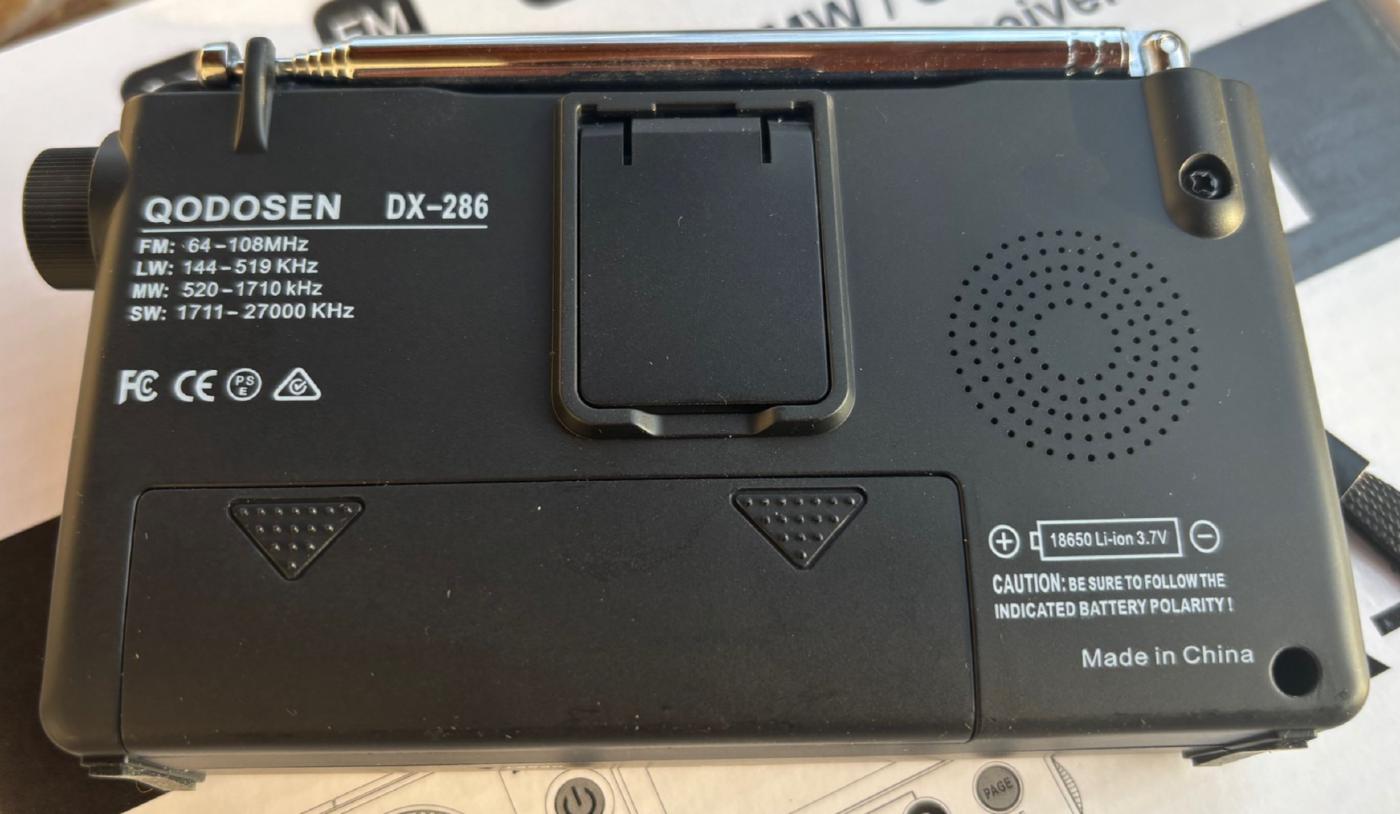
The back of the DX-268—with a fold-out tab
The user guide is included, and the description is very good; unfortunately, however, it is only available in English. To make it easier to get started, I have created a German-language device description for the DX-286. According to Qodosen, German-language user manuals will also be available soon.
The basic functions
Everyone tests a new device in their own way. For me personally, I always start by familiarizing myself with the basic functions. This includes setting the time. There's no question that the DX-286 can do this. And not only that. You can choose from 24 different local times – as many time zones as there are on Earth. In addition to the respective local time, the device always displays the corresponding world time. This is an extremely practical feature, especially for active DXers who not only listen but also deal with transmission schedules and/or reception reports.
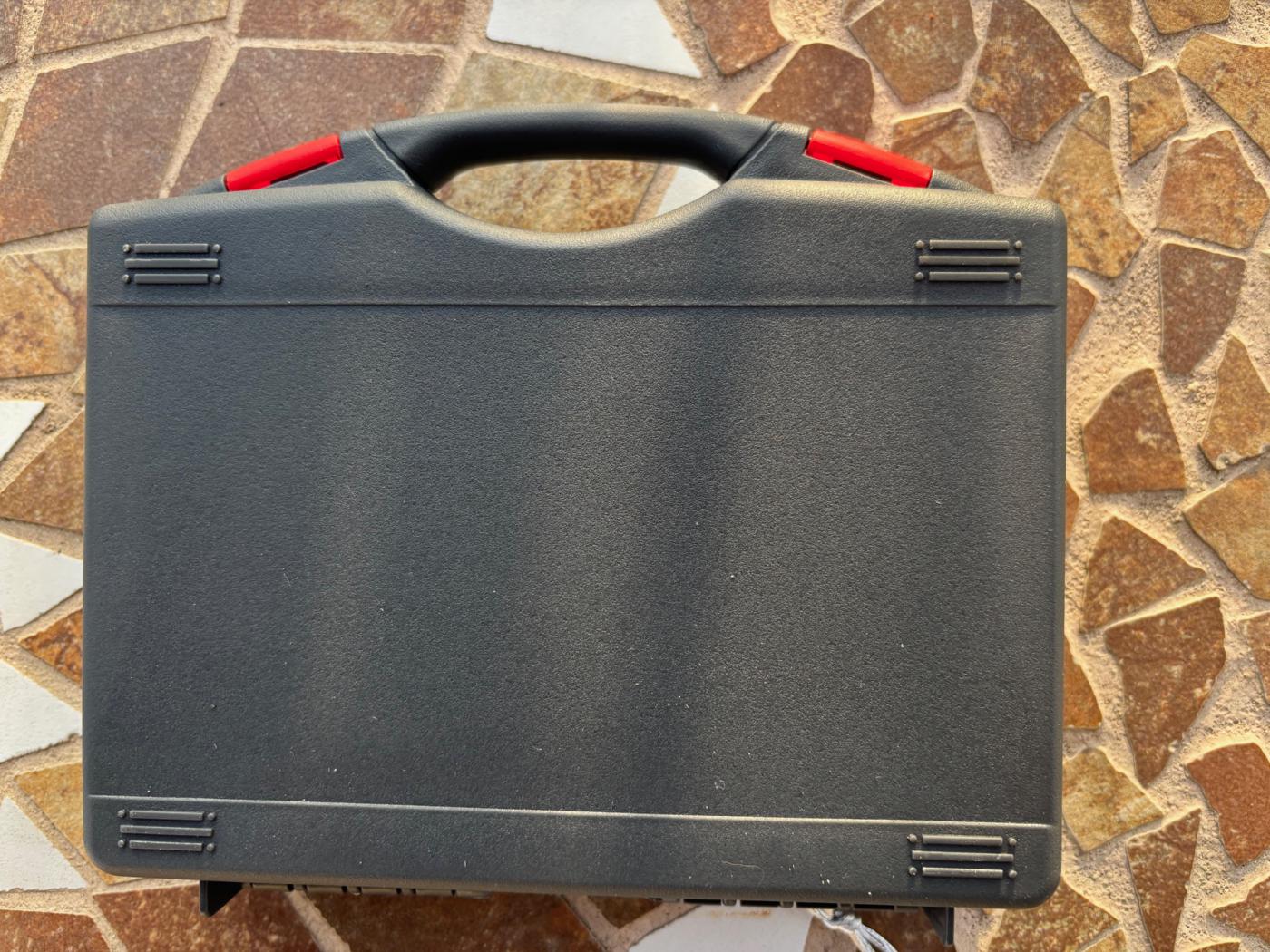
Everything waterproof packed in a cute little case
All conceivable radio alarm clock functions are also available: on/off, wake up to music or a buzzer, and there is even a snooze function, which delays the radio or alarm tone by 5 minutes.
The memory capacity is also generous. A total of 1000 stations and frequencies can be stored, divided into 100 blocks, known as “pages,” each with 10 stations. Are there really people who can receive that many stations?
A jack plug socket allows you to connect the radio to either headphones or an external amplifier. FM stations can then be listened to in stereo. But even with its built-in, very small speakers, the DX-286 is a real sound marvel – especially thanks to its generous bandwidth switching, which will be discussed in more detail in the following chapter. Earphones are not currently included in the scope of delivery.
The receiver's largely self-explanatory display has its own backlight, which remains active for 10 seconds when the device is switched on or when switching to another frequency. Users also have the option of activating the light permanently, but this always comes at the expense of battery life.
If you find the beeping sound when entering frequencies annoying, you can simply deactivate it – and vice versa. The little DX-286 can do that too.
Qodosen has come up with something special when it comes to the battery: a fully charged micro USB battery in the form of a slightly oversized battery (18,650) is included in the scope of delivery. A cable for charging, e.g., via a PC, is also included as an accessory. A 5V USB charger is not included – presumably because our households are already well equipped with such devices in today's smartphone era. The radio is extremely economical in terms of power consumption. It can be operated for many hours without recharging the battery. The radio has a “smart charging function”: as soon as the radio is connected to a charger, the charging process begins and stops automatically when the battery is fully charged. This helps to save electricity and also protects the battery considerably.
If you want to take the DX-286 with you when traveling, there is also a “LOCK” function that prevents the device from being switched on accidentally.
Last but not least, there is also a “MUTE” button that can be used to mute the radio temporarily if the phone rings.
The antennas
Many possibilities:
The Qodosen DX-286 offers different antenna solutions for medium and long wave, depending on whether you are indoors or outdoors. The manufacturer recommends using the built-in ferrite antenna for indoor use. For outdoor use, you have the option of switching to the telescopic antenna. However, it may well be worth experimenting with this.
The telescopic antenna is available for shortwave. The device has a preamplifier that can be switched on at the touch of a button (“Antenna Amp Switch”), which is particularly useful for weaker stations. This significantly amplifies the signal. I think it does no harm to leave the preamplifier switched on and deactivate it if necessary when a station is too strong. I have not yet encountered such a situation. The attenuator is interesting, as it allows you to selectively and gradually adjust the antenna to the required signal strength. Again, a simple push of a button is all it takes. The attenuator can be used and adjusted in the shortwave, medium wave, and longwave ranges. The integrated adjustable antenna attenuator also improves overload resistance.
The built-in telescopic antenna is used for FM.
For all reception modes, there is also the option of using an external antenna. The device has a jack plug socket for this purpose. It is important to note that an external antenna in the AM range only works in the so-called “external” range, i.e., with “Antenna Amp Off.” However, this does not matter for FM. The possibilities offered by an external antenna are particularly impressive in the AM range.
FM
The frequency spectrum for FM ranges from 64 MHz to 108 MHz. Depending on your preferences or the region you are in, there are five different FM settings ranging from FM-64-108M to FM87.5-108M. The setting can be changed at any time at the touch of a button. The search mode, i.e., the increment when turning the side search knob, can also be varied—from 30K to 50K, 100K, 200K, and up to 250K, anything is possible.
Pressing the FM button once briefly switches the device to FM mode. Pressing it for more than 2 seconds starts the station search – saving the stations found if necessary. To enter the transmission frequency, the user has the option of entering the relevant data directly via the number pad and then confirming with the FM button. Another option is the rotary knob on the right-hand side, which can be used to switch to the next higher or lower frequency, depending on the step size setting. You can also set your favorite station using the device's search and memory functions. Stations can generally be received in stereo, but this can only be activated if the device is connected to headphones or a stereo amplifier.
The “M/Tone” button can be used to adjust the sound: in addition to a music mode, there is also a speech mode. I couldn't hear much difference with this switch option on FM, but I could on AM.
The reception performance is indeed impressive. Like the Deepelec DP-666, the Qodosen DX-286 also has a TEF6686 chip built in. I was able to compare both devices. In this regard, the DX-286 is at least on par with the Deepelec in terms of both signal strength and selectivity. It is quite clear that there is still room for improvement with the TEF6686 through configuration and fine-tuning. Traditional receivers such as the Grundig Satellit 700 or the Sony ICF7600GR can keep up when it comes to FM reception. As already mentioned, FM reception is excellent. But that’s not all. The user also has the option of bandwidth selection. Sixteen different bandwidths are available—in addition to the already very well-configured automatic mode.
On FM, the DX-286 has the option of activating RDS (Europe) or RBDS (USA). This allows you to display the station name and, if applicable, the program type, the title being played, etc. When RDS is active, the RDS button can be used to switch between the different RDS segments.
For my tests and comparisons, I used the Grundig Satellit 700, the Sony ICF 7600 GR, and the small Deepelec DP-666, which has very strong FM reception, as reference devices. The reception performance of the Chinese DX-286 was similarly good to the DP-666 and far better in all other cases. However, surpassing the DP-666 on FM is not that easy. Neither the Grundig Satellit 700 nor the Sony ICF 7600 GR could keep up with the small DX-286.
The sound quality of the stations played is amazingly good considering the size of the device and its speaker. Here's another example: “Deutschlandradio Kultur” broadcasts at 200 watts from Berliner Allee in Freiburg i. Br. and can be received here in Herbolzheim in northern Breisgau without any problems or interference. The same applies to “uniFM,” which broadcasts at 300 watts from the Freiburg University Hospital. Freies Radio Wiesental, 500 watts and 60 km away, could also be heard with both the DP-666 and the Qodosen DX-286. The two reference devices had to pass on all three stations.
The small Chinese radio offers another advantage in the form of FM signal processing: in activated FM mode, the “Set” button allows you to choose from three different DX modes in addition to the preset standard, making even weak signals easier to hear.
Longwave / Mediumwave
Longwave and medium wave can also be received with the Qodosen DX-286. The device has a built-in ferrite antenna for this purpose. A new and unusual feature is the option of using the telescopic antenna for this purpose, which can be particularly advantageous when outdoors. Here, too, you have the option of entering the desired frequency directly or changing it using the dial at the top right. Saving stations is just as easy with AM as it is with FM.
Longwave must first be activated on the DX-286. There is no longwave in the factory settings. However, activation or deactivation is very simple – using the same function that is used to change the FM mode and the step size when searching for stations: Turn off the device, then simply press “Set” and activate “LW.” By repeatedly pressing the AM button briefly, you can then switch back and forth between longwave, mediumwave, and shortwave.
The device has a filter that can suppress or completely eliminate various types of interference. This is particularly effective in households where the Wi-Fi signal is distributed via power outlets (“powerline”), which usually renders AM unusable. Another great feature in the long, medium, and shortwave ranges is the four-stage bandwidth switch, which is also available on the Deepelec DP-666, but is obviously less finely configured and does not deliver signals as clear as the Qodosen DX-286. With the external antenna activated, an antenna preamplifier can be activated in the long and medium wave range, which also makes weaker signals audible.
Especially in the AM range, connecting an external antenna offers further possibilities for optimizing reception. This is not absolutely necessary, as the signal strength is surprisingly good even without connecting an external antenna when the preamplifier is activated. Nevertheless, a good external antenna is very helpful, especially for weaker signals – for example, for nighttime overseas reception from the USA or Canada. In order for an external antenna to actually work for the long and medium wave ranges, you have to switch to ANT-EXT, i.e., to the telescopic or external antenna.
The SQUELCH function is very helpful for AM reception, as it allows you to suppress station noise in 10 steps. It is available for the entire AM range, i.e., long, medium, and short wave. Depending on the strength of the signal, SQUELCH is a great help, and it is very pleasant to hear a station with more or less no noise. However, as with other receivers, the threshold value is often too low for very weak signals, so it is not recommended to switch on SQUELCH in such cases.
As is well known, here in Germany there is nothing to hear on medium wave until after dark. The DX-286's medium wave spectrum ranges from 522 to 1710 KHz and can be adjusted in steps of 1, 9 or 10 KHz. By pressing the knob repeatedly, you can switch from “fast” (9 kHz or 10 kHz steps) to ‘slow’ (1 kHz steps). Pressing the button several times also activates an “Auto” mode, which searches for the next receivable station.
Shortwave
The shortwave range extends seamlessly from 1,711 KHz to 27,000 KHz. Just like the other bands, the shortwave can be tuned using the rotary knob or by entering the frequency directly. Automatic station search is available, as are a wide range of memory options and four-fold bandwidth switching. However, the device does not have SSB with the current software version.
The reception performance with the built-in telescopic antenna is exceptional in the shortwave range—especially when the antenna preamplifier is activated. On all shortwave bands, the noise level is significantly lower and the signal strength considerably better with the built-in telescopic antenna than with, for example, the Grundig Satellit 700 or the Sony ICF 7600 GR.
The device also offers the option of connecting an external antenna to the jack socket for shortwave, which actually opens up further amazing possibilities in the shortwave range. A practical example: when I connect the device to my rotatable Wellbrook Loop roof antenna, even seemingly inaudible stations become audible. For example, in the early hours of the morning, I was able to log the Mexican station XEPPM Radio Education on 6185 KHz with a usable signal (but even with the built-in antenna, the station was still audible) – and during the day, the otherwise rather noisy “Channel 292” on 6070 KHz can be heard wonderfully clearly. Overall, when I connect the Wellbrook Loop, the DX-286 can almost keep up with a JRC NRD – which is really remarkable.
Conclusion
Relative to its size and weight, the Qodosen DX-286 not only offers a surprising variety of settings. It particularly impresses with its excellent reception performance, selectivity, and signal processing. Even without SSB, the DX-286 is a top-class world receiver—in a miniature format. All this and more for less than $90. The small Qodosen makes listening to the radio and DXing great fun – indoors and outdoors. Weighing just under 250 grams, this tiny device can also be taken anywhere – and the “Lock” function is extremely useful for this.
I have tested many world receivers. The Qodosen DX-286 is one of the best ever. My conclusion: Highly recommended.
Links:
This Review: https://www.helmutmatt.de/qodosen_e
German manual: https://www.helmutmatt.de/qodosen_manual_e.html
“That's a pretty nice little toolbox,” my wife remarked as I took the Qodosen DX-286 out of the box. And indeed, this sleek world receiver isn't just very well packaged, but also perfectly protected against damage during transport: it comes in an elegantly designed case with plenty of room for the well-packed radio and all its accessories.
Well packed
The package includes a charging cable, the appropriate battery, and a carrying case that is as soft and fluffy as it is practical, designed to protect the device from scratches. The case also contains two stickers—one of them brightly colored, the other listing the world receiver’s key features.
Small—black—strong! That’s how Italian espresso is usually described. But these attributes also apply to the latest development from Qodosen. The truly amazing features of the DX-286 will be discussed below.
Weighing just under 250 grams, this little all-rounder from southern China comes complete with a rechargeable and replaceable battery. Measuring 12 x 7 x 2.5 cm, it definitely belongs in the category of “the world’s smallest world receiver.” Its status as one of the most high-performance radios is ensured, among other things, by the built-in and carefully configured TEF6686 chip, which has also delivered impressive results in radios from other manufacturers.
Particularly user-friendly features include the clear display, direct frequency entry, and, last but not least, the fold-out tab on the back, which allows the device to be positioned comfortably.
The back of the DX-268—with a fold-out tab
The user guide is included, and the description is very good; unfortunately, however, it is only available in English. To make it easier to get started, I have created a German-language device description for the DX-286. According to Qodosen, German-language user manuals will also be available soon.
The basic functions
Everyone tests a new device in their own way. For me personally, I always start by familiarizing myself with the basic functions. This includes setting the time. There's no question that the DX-286 can do this. And not only that. You can choose from 24 different local times – as many time zones as there are on Earth. In addition to the respective local time, the device always displays the corresponding world time. This is an extremely practical feature, especially for active DXers who not only listen but also deal with transmission schedules and/or reception reports.
Everything waterproof packed in a cute little case
All conceivable radio alarm clock functions are also available: on/off, wake up to music or a buzzer, and there is even a snooze function, which delays the radio or alarm tone by 5 minutes.
The memory capacity is also generous. A total of 1000 stations and frequencies can be stored, divided into 100 blocks, known as “pages,” each with 10 stations. Are there really people who can receive that many stations?
A jack plug socket allows you to connect the radio to either headphones or an external amplifier. FM stations can then be listened to in stereo. But even with its built-in, very small speakers, the DX-286 is a real sound marvel – especially thanks to its generous bandwidth switching, which will be discussed in more detail in the following chapter. Earphones are not currently included in the scope of delivery.
The receiver's largely self-explanatory display has its own backlight, which remains active for 10 seconds when the device is switched on or when switching to another frequency. Users also have the option of activating the light permanently, but this always comes at the expense of battery life.
If you find the beeping sound when entering frequencies annoying, you can simply deactivate it – and vice versa. The little DX-286 can do that too.
Qodosen has come up with something special when it comes to the battery: a fully charged micro USB battery in the form of a slightly oversized battery (18,650) is included in the scope of delivery. A cable for charging, e.g., via a PC, is also included as an accessory. A 5V USB charger is not included – presumably because our households are already well equipped with such devices in today's smartphone era. The radio is extremely economical in terms of power consumption. It can be operated for many hours without recharging the battery. The radio has a “smart charging function”: as soon as the radio is connected to a charger, the charging process begins and stops automatically when the battery is fully charged. This helps to save electricity and also protects the battery considerably.
If you want to take the DX-286 with you when traveling, there is also a “LOCK” function that prevents the device from being switched on accidentally.
Last but not least, there is also a “MUTE” button that can be used to mute the radio temporarily if the phone rings.
The antennas
Many possibilities:
The Qodosen DX-286 offers different antenna solutions for medium and long wave, depending on whether you are indoors or outdoors. The manufacturer recommends using the built-in ferrite antenna for indoor use. For outdoor use, you have the option of switching to the telescopic antenna. However, it may well be worth experimenting with this.
The telescopic antenna is available for shortwave. The device has a preamplifier that can be switched on at the touch of a button (“Antenna Amp Switch”), which is particularly useful for weaker stations. This significantly amplifies the signal. I think it does no harm to leave the preamplifier switched on and deactivate it if necessary when a station is too strong. I have not yet encountered such a situation. The attenuator is interesting, as it allows you to selectively and gradually adjust the antenna to the required signal strength. Again, a simple push of a button is all it takes. The attenuator can be used and adjusted in the shortwave, medium wave, and longwave ranges. The integrated adjustable antenna attenuator also improves overload resistance.
The built-in telescopic antenna is used for FM.
For all reception modes, there is also the option of using an external antenna. The device has a jack plug socket for this purpose. It is important to note that an external antenna in the AM range only works in the so-called “external” range, i.e., with “Antenna Amp Off.” However, this does not matter for FM. The possibilities offered by an external antenna are particularly impressive in the AM range.
FM
The frequency spectrum for FM ranges from 64 MHz to 108 MHz. Depending on your preferences or the region you are in, there are five different FM settings ranging from FM-64-108M to FM87.5-108M. The setting can be changed at any time at the touch of a button. The search mode, i.e., the increment when turning the side search knob, can also be varied—from 30K to 50K, 100K, 200K, and up to 250K, anything is possible.
Pressing the FM button once briefly switches the device to FM mode. Pressing it for more than 2 seconds starts the station search – saving the stations found if necessary. To enter the transmission frequency, the user has the option of entering the relevant data directly via the number pad and then confirming with the FM button. Another option is the rotary knob on the right-hand side, which can be used to switch to the next higher or lower frequency, depending on the step size setting. You can also set your favorite station using the device's search and memory functions. Stations can generally be received in stereo, but this can only be activated if the device is connected to headphones or a stereo amplifier.
The “M/Tone” button can be used to adjust the sound: in addition to a music mode, there is also a speech mode. I couldn't hear much difference with this switch option on FM, but I could on AM.
The reception performance is indeed impressive. Like the Deepelec DP-666, the Qodosen DX-286 also has a TEF6686 chip built in. I was able to compare both devices. In this regard, the DX-286 is at least on par with the Deepelec in terms of both signal strength and selectivity. It is quite clear that there is still room for improvement with the TEF6686 through configuration and fine-tuning. Traditional receivers such as the Grundig Satellit 700 or the Sony ICF7600GR can keep up when it comes to FM reception. As already mentioned, FM reception is excellent. But that’s not all. The user also has the option of bandwidth selection. Sixteen different bandwidths are available—in addition to the already very well-configured automatic mode.
On FM, the DX-286 has the option of activating RDS (Europe) or RBDS (USA). This allows you to display the station name and, if applicable, the program type, the title being played, etc. When RDS is active, the RDS button can be used to switch between the different RDS segments.
For my tests and comparisons, I used the Grundig Satellit 700, the Sony ICF 7600 GR, and the small Deepelec DP-666, which has very strong FM reception, as reference devices. The reception performance of the Chinese DX-286 was similarly good to the DP-666 and far better in all other cases. However, surpassing the DP-666 on FM is not that easy. Neither the Grundig Satellit 700 nor the Sony ICF 7600 GR could keep up with the small DX-286.
The sound quality of the stations played is amazingly good considering the size of the device and its speaker. Here's another example: “Deutschlandradio Kultur” broadcasts at 200 watts from Berliner Allee in Freiburg i. Br. and can be received here in Herbolzheim in northern Breisgau without any problems or interference. The same applies to “uniFM,” which broadcasts at 300 watts from the Freiburg University Hospital. Freies Radio Wiesental, 500 watts and 60 km away, could also be heard with both the DP-666 and the Qodosen DX-286. The two reference devices had to pass on all three stations.
The small Chinese radio offers another advantage in the form of FM signal processing: in activated FM mode, the “Set” button allows you to choose from three different DX modes in addition to the preset standard, making even weak signals easier to hear.
Longwave / Mediumwave
Longwave and medium wave can also be received with the Qodosen DX-286. The device has a built-in ferrite antenna for this purpose. A new and unusual feature is the option of using the telescopic antenna for this purpose, which can be particularly advantageous when outdoors. Here, too, you have the option of entering the desired frequency directly or changing it using the dial at the top right. Saving stations is just as easy with AM as it is with FM.
Longwave must first be activated on the DX-286. There is no longwave in the factory settings. However, activation or deactivation is very simple – using the same function that is used to change the FM mode and the step size when searching for stations: Turn off the device, then simply press “Set” and activate “LW.” By repeatedly pressing the AM button briefly, you can then switch back and forth between longwave, mediumwave, and shortwave.
The device has a filter that can suppress or completely eliminate various types of interference. This is particularly effective in households where the Wi-Fi signal is distributed via power outlets (“powerline”), which usually renders AM unusable. Another great feature in the long, medium, and shortwave ranges is the four-stage bandwidth switch, which is also available on the Deepelec DP-666, but is obviously less finely configured and does not deliver signals as clear as the Qodosen DX-286. With the external antenna activated, an antenna preamplifier can be activated in the long and medium wave range, which also makes weaker signals audible.
Especially in the AM range, connecting an external antenna offers further possibilities for optimizing reception. This is not absolutely necessary, as the signal strength is surprisingly good even without connecting an external antenna when the preamplifier is activated. Nevertheless, a good external antenna is very helpful, especially for weaker signals – for example, for nighttime overseas reception from the USA or Canada. In order for an external antenna to actually work for the long and medium wave ranges, you have to switch to ANT-EXT, i.e., to the telescopic or external antenna.
The SQUELCH function is very helpful for AM reception, as it allows you to suppress station noise in 10 steps. It is available for the entire AM range, i.e., long, medium, and short wave. Depending on the strength of the signal, SQUELCH is a great help, and it is very pleasant to hear a station with more or less no noise. However, as with other receivers, the threshold value is often too low for very weak signals, so it is not recommended to switch on SQUELCH in such cases.
As is well known, here in Germany there is nothing to hear on medium wave until after dark. The DX-286's medium wave spectrum ranges from 522 to 1710 KHz and can be adjusted in steps of 1, 9 or 10 KHz. By pressing the knob repeatedly, you can switch from “fast” (9 kHz or 10 kHz steps) to ‘slow’ (1 kHz steps). Pressing the button several times also activates an “Auto” mode, which searches for the next receivable station.
Shortwave
The shortwave range extends seamlessly from 1,711 KHz to 27,000 KHz. Just like the other bands, the shortwave can be tuned using the rotary knob or by entering the frequency directly. Automatic station search is available, as are a wide range of memory options and four-fold bandwidth switching. However, the device does not have SSB with the current software version.
The reception performance with the built-in telescopic antenna is exceptional in the shortwave range—especially when the antenna preamplifier is activated. On all shortwave bands, the noise level is significantly lower and the signal strength considerably better with the built-in telescopic antenna than with, for example, the Grundig Satellit 700 or the Sony ICF 7600 GR.
The device also offers the option of connecting an external antenna to the jack socket for shortwave, which actually opens up further amazing possibilities in the shortwave range. A practical example: when I connect the device to my rotatable Wellbrook Loop roof antenna, even seemingly inaudible stations become audible. For example, in the early hours of the morning, I was able to log the Mexican station XEPPM Radio Education on 6185 KHz with a usable signal (but even with the built-in antenna, the station was still audible) – and during the day, the otherwise rather noisy “Channel 292” on 6070 KHz can be heard wonderfully clearly. Overall, when I connect the Wellbrook Loop, the DX-286 can almost keep up with a JRC NRD – which is really remarkable.
Conclusion
Relative to its size and weight, the Qodosen DX-286 not only offers a surprising variety of settings. It particularly impresses with its excellent reception performance, selectivity, and signal processing. Even without SSB, the DX-286 is a top-class world receiver—in a miniature format. All this and more for less than $90. The small Qodosen makes listening to the radio and DXing great fun – indoors and outdoors. Weighing just under 250 grams, this tiny device can also be taken anywhere – and the “Lock” function is extremely useful for this.
I have tested many world receivers. The Qodosen DX-286 is one of the best ever. My conclusion: Highly recommended.
Links:
This Review: https://www.helmutmatt.de/qodosen_e
German manual: https://www.helmutmatt.de/qodosen_manual_e.html