XHDATA D-219
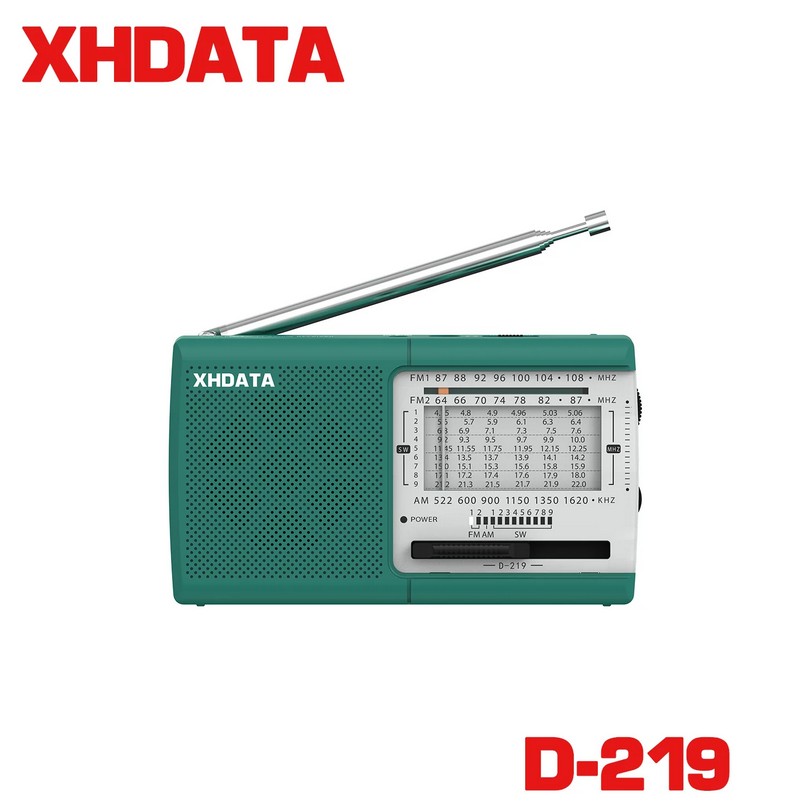
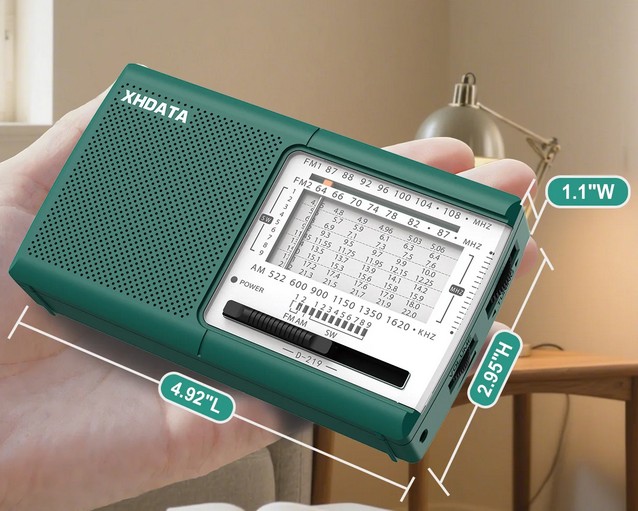
Bright green! Finally, no more boring gray on gray, which we seem to have become accustomed to. The new D-219 is also available in gray and silver, of course, but with the new colors, the Dongguan City-based company XHDATA in the southern Chinese province of Guangdong is setting some really beautiful new accents. In any case, I am very happy about the new look.
The radio weighs a total of 150 grams. Even with the two AA batteries, it weighs less than 200 grams. Ideal for taking with you on trips or for hours in the garden.
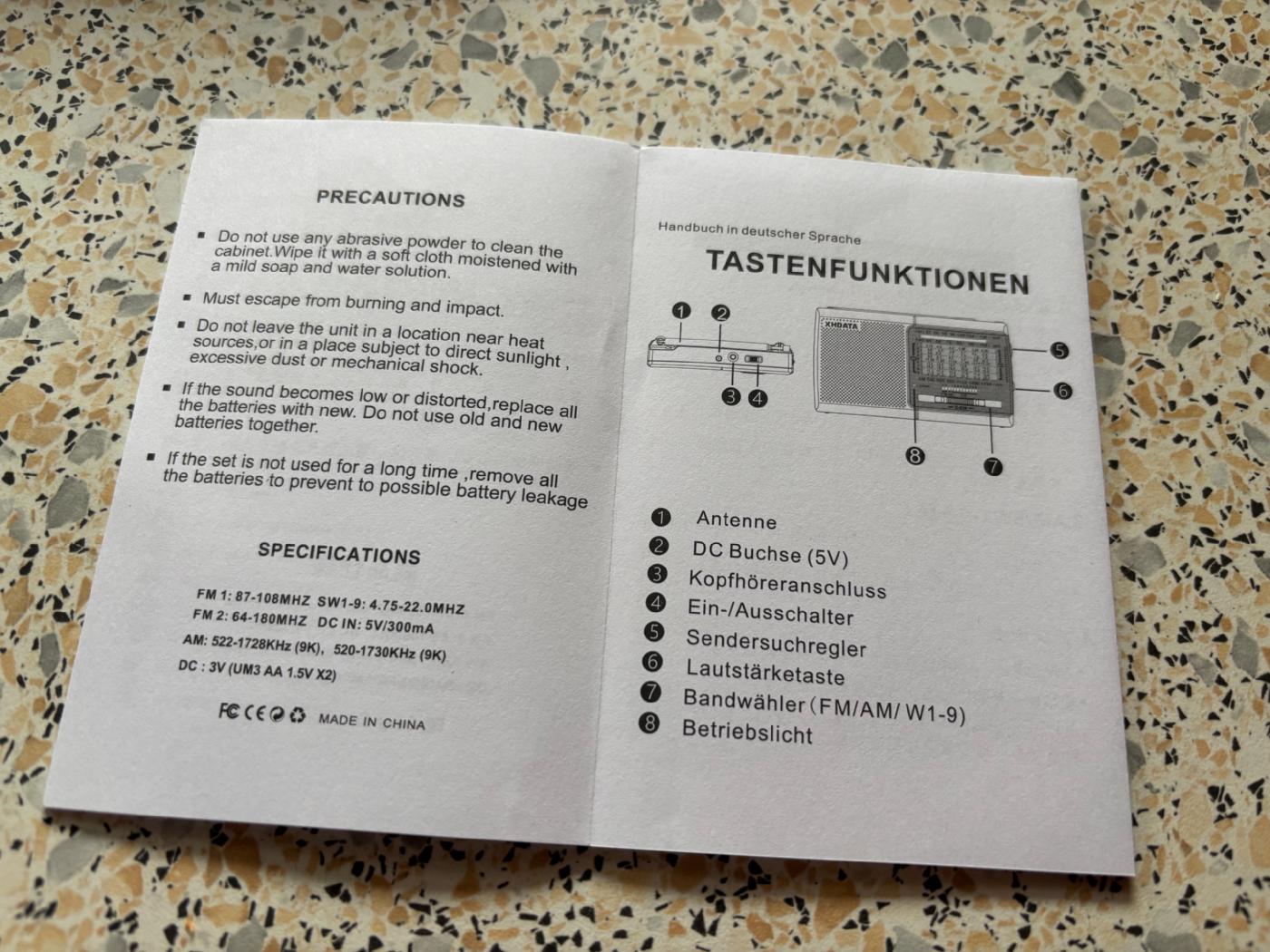
A brief description of the device is included. This data sheet focuses on the essentials: two photos, the technical specifications, the individual functions and how to use them, and the prescribed precautions. And all this in seven languages: English, German, French, Italian, Spanish, Japanese, and Russian.
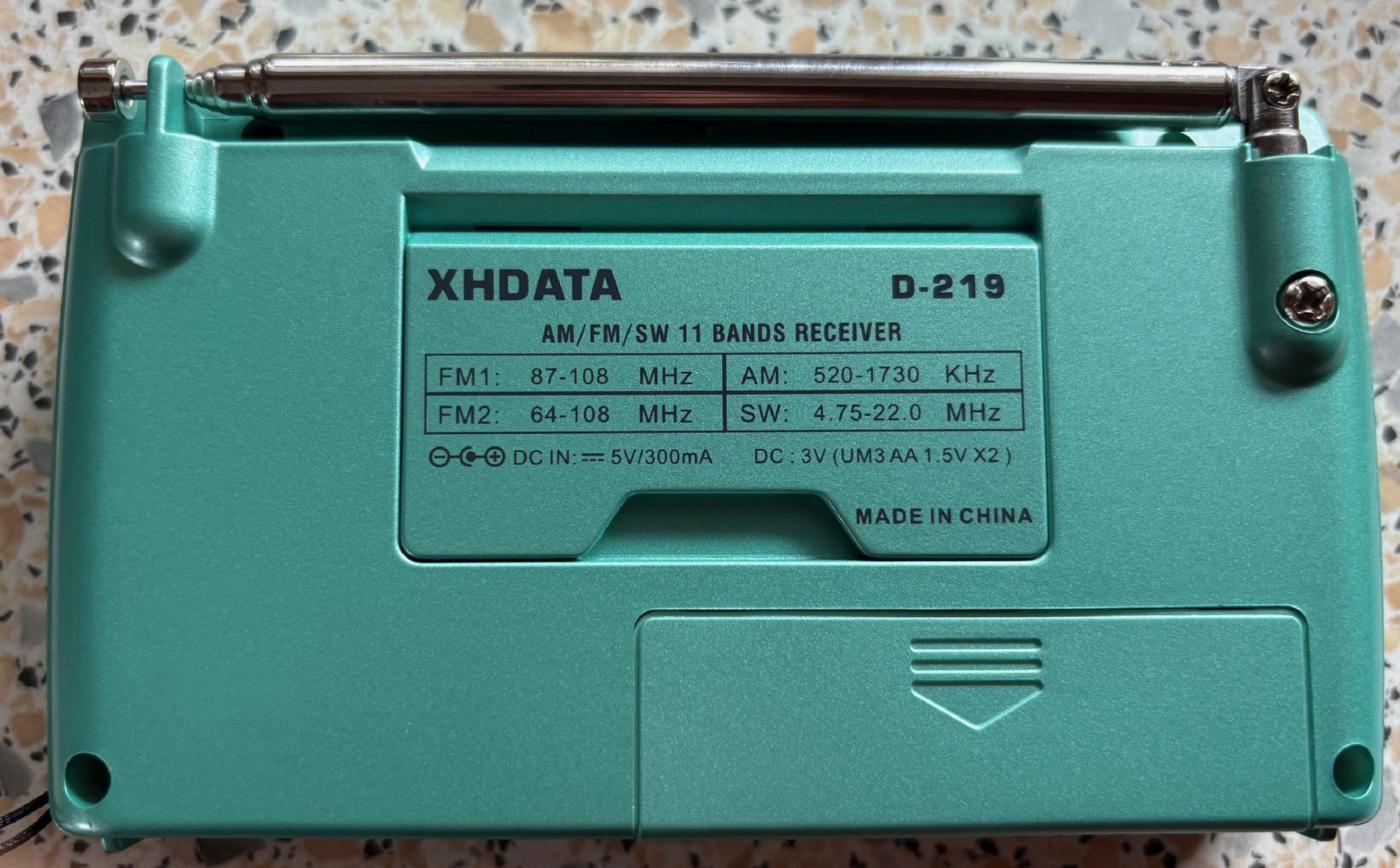
There is a sturdy tab at the bottom right for easy transport. Very user-friendly, there is a flap on the back where you can not only read the most important technical data, but which you can also pull out to put the radio in a stable semi-slanted position.
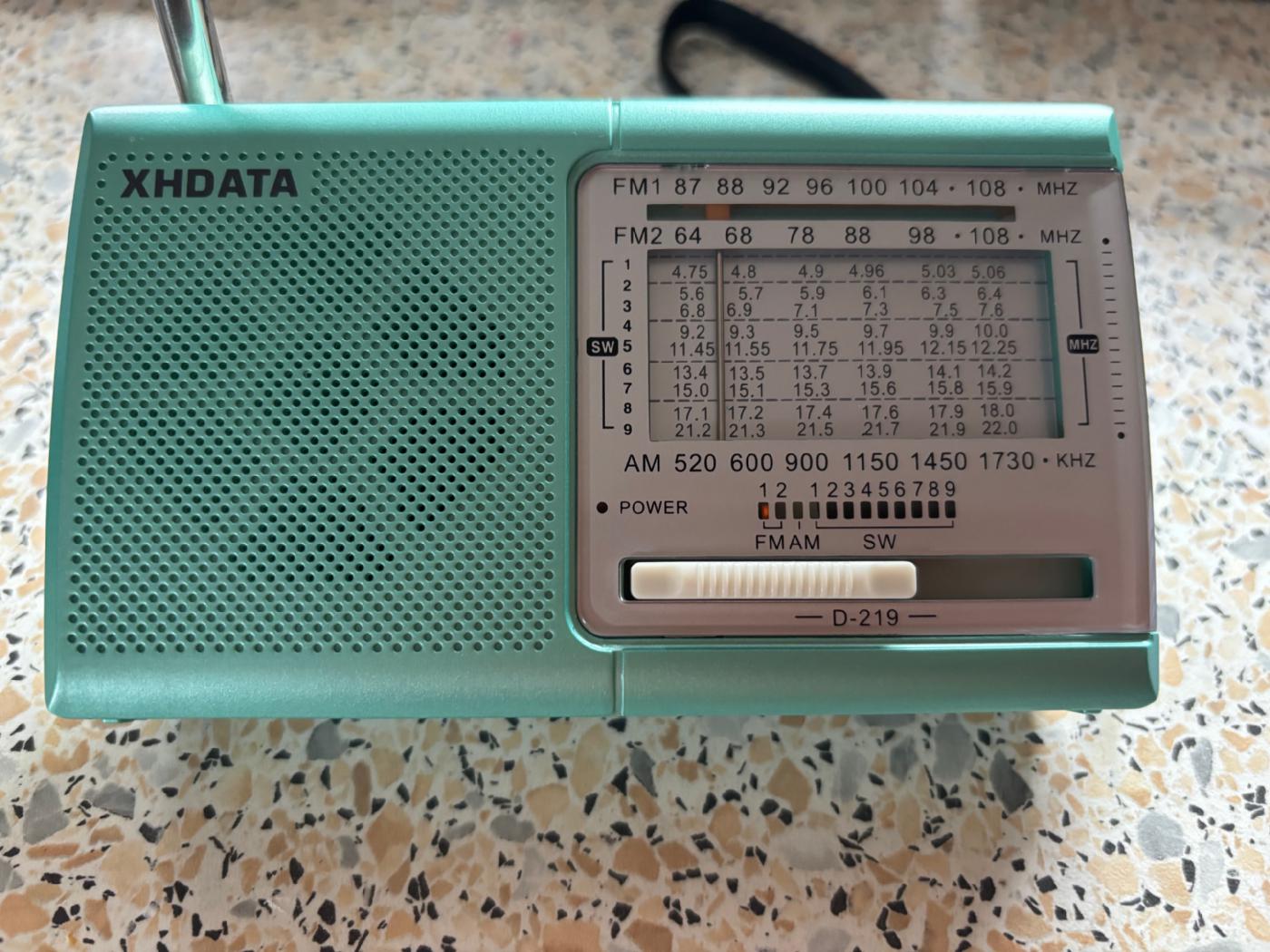
The small D-219 does not have digital frequency input, which is not particularly surprising given its price of less than EUR 20.00. This means that tuning in to stations is not quite as easy as with its larger “brothers” – but it is still not too problematic. Finding smaller stations in the AM range with weaker signals also requires a little bit of skill and practice. In any case, I quickly got the hang of it.
Technical data
On the top, in front of the extendable telescopic antenna, you will find the on/off switch, a headphone jack, and a jack for transformer operation. With the transformers available today, I would personally strongly advise against using them for AM ranges in particular, as they almost always cause serious interference. In addition, the device is extremely economical in terms of power consumption, so the batteries have a fairly long operating life. Of course, rechargeable batteries can also be used. On the right, there is a knob for tuning the station and below it a knob for adjusting the volume. On the left front side, under the XHDATA logo, there is a small but surprisingly powerful speaker, and on the right is the scale and the switch for selecting the individual frequency ranges.
FM
FM is available twice: FM1 from 87 MHz to 108 MHz, FM2 from 64 MHz to 108 MHz. The lower frequency range is likely to be of particular interest in some Eastern European regions.
FM reception is remarkable. Strong stations are very easy to tune in, while smaller, weaker stations require a little more finesse. This is also the case on the other bands.
As reference devices, I used the Sony ICF 7200 GR and the small Deepelec DP-666, which has very strong FM reception. While the reception performance of the Chinese D-219 comes very close to that of the DP-666, the Sony cannot keep up. The sound of the stations played is also extremely brilliant. An example: Deutschlandradio Kultur broadcasts with 200 watts from Berliner Allee in Freiburg i. Br. and can be received here in Herbolzheim in northern Breisgau without any problems or interference. The same applies to uniFM, which broadcasts from the Freiburg University Hospital with 300 watts. Even Freies Radio Wiesental (500 watts) can be heard, albeit not completely noise-free. After all, it is almost 60 km from here to the transmitter.
AM
During the day, there is practically nothing to be heard on the medium wave bands because there are only very small transmitters left in Germany for this range. However, the situation is completely different after dark. Sounds from Spain and Eastern Europe in particular can be received without any problems with the built-in ferrite antenna. But there's much more: even the museum radio station from Bad Ischl (1476 KHz with 1 KW) can be received here in Breisgau without any problems – and after it goes off late in the evening, with a little luck you can even hear the unfamiliar sounds of Radio Keralam from Ras al-Khaima in the United Arab Emirates on the same frequency. I particularly like the fact that the medium wave range extends from 520 KHz to 1730 KHz, which should be of particular interest to fans of pirate music stations from the Netherlands and Greece. The two reference radios are no match for the small D-219.
SW
Shortwave is divided into nine bands and spread out. It's a bit of a shame that the 75-meter band is not included, because not only does the popular Channel 292 broadcast there, but in the evenings KBS World Radio from Seoul (with a transmitter location in the UK) also broadcasts with excellent reception quality.
The band spread makes shortwave stations relatively easy to tune in to – especially for experienced DXers, radio listeners, and shortwave listeners. Shortwave frequencies from 4,750 KHz to 22,000 KHz are available. Intermediate frequencies such as 6,400 KHz to 6,800 KHz or 10,000 KHz to 11,450 KHz have been omitted because only so-called utility stations can be received there anyway.
Reception in the shortwave range was also very good, with both the Sony and Deepelec being surpassed in terms of reception performance. The Grundig Satellit 700 was the only model that came close.
Conclusion
Overall, XHDATA has developed the D-219, an amazingly powerful and, in my opinion, visually appealing radio for very little money. A delicate touch and finesse are necessary for smooth operation—but in return, the user is rewarded with truly astonishing results. If I didn't already have one, I would buy it! The silver-gray version costs just under 20 euros, and even less in China. As far as I know, the beautiful new green version is not yet freely available in Europe, but it will be very soon. You can take a look at the new D-219 here: https://www.xhdata.com.cn/products/xhdata-d-219-radio
Bright green! Finally, no more boring gray on gray, which we seem to have become accustomed to. The new D-219 is also available in gray and silver, of course, but with the new colors, the Dongguan City-based company XHDATA in the southern Chinese province of Guangdong is setting some really beautiful new accents. In any case, I am very happy about the new look.
The radio weighs a total of 150 grams. Even with the two AA batteries, it weighs less than 200 grams. Ideal for taking with you on trips or for hours in the garden.
A brief description of the device is included. This data sheet focuses on the essentials: two photos, the technical specifications, the individual functions and how to use them, and the prescribed precautions. And all this in seven languages: English, German, French, Italian, Spanish, Japanese, and Russian.
There is a sturdy tab at the bottom right for easy transport. Very user-friendly, there is a flap on the back where you can not only read the most important technical data, but which you can also pull out to put the radio in a stable semi-slanted position.
The small D-219 does not have digital frequency input, which is not particularly surprising given its price of less than EUR 20.00. This means that tuning in to stations is not quite as easy as with its larger “brothers” – but it is still not too problematic. Finding smaller stations in the AM range with weaker signals also requires a little bit of skill and practice. In any case, I quickly got the hang of it.
Technical data
On the top, in front of the extendable telescopic antenna, you will find the on/off switch, a headphone jack, and a jack for transformer operation. With the transformers available today, I would personally strongly advise against using them for AM ranges in particular, as they almost always cause serious interference. In addition, the device is extremely economical in terms of power consumption, so the batteries have a fairly long operating life. Of course, rechargeable batteries can also be used. On the right, there is a knob for tuning the station and below it a knob for adjusting the volume. On the left front side, under the XHDATA logo, there is a small but surprisingly powerful speaker, and on the right is the scale and the switch for selecting the individual frequency ranges.
FM
FM is available twice: FM1 from 87 MHz to 108 MHz, FM2 from 64 MHz to 108 MHz. The lower frequency range is likely to be of particular interest in some Eastern European regions.
FM reception is remarkable. Strong stations are very easy to tune in, while smaller, weaker stations require a little more finesse. This is also the case on the other bands.
As reference devices, I used the Sony ICF 7200 GR and the small Deepelec DP-666, which has very strong FM reception. While the reception performance of the Chinese D-219 comes very close to that of the DP-666, the Sony cannot keep up. The sound of the stations played is also extremely brilliant. An example: Deutschlandradio Kultur broadcasts with 200 watts from Berliner Allee in Freiburg i. Br. and can be received here in Herbolzheim in northern Breisgau without any problems or interference. The same applies to uniFM, which broadcasts from the Freiburg University Hospital with 300 watts. Even Freies Radio Wiesental (500 watts) can be heard, albeit not completely noise-free. After all, it is almost 60 km from here to the transmitter.
AM
During the day, there is practically nothing to be heard on the medium wave bands because there are only very small transmitters left in Germany for this range. However, the situation is completely different after dark. Sounds from Spain and Eastern Europe in particular can be received without any problems with the built-in ferrite antenna. But there's much more: even the museum radio station from Bad Ischl (1476 KHz with 1 KW) can be received here in Breisgau without any problems – and after it goes off late in the evening, with a little luck you can even hear the unfamiliar sounds of Radio Keralam from Ras al-Khaima in the United Arab Emirates on the same frequency. I particularly like the fact that the medium wave range extends from 520 KHz to 1730 KHz, which should be of particular interest to fans of pirate music stations from the Netherlands and Greece. The two reference radios are no match for the small D-219.
SW
Shortwave is divided into nine bands and spread out. It's a bit of a shame that the 75-meter band is not included, because not only does the popular Channel 292 broadcast there, but in the evenings KBS World Radio from Seoul (with a transmitter location in the UK) also broadcasts with excellent reception quality.
The band spread makes shortwave stations relatively easy to tune in to – especially for experienced DXers, radio listeners, and shortwave listeners. Shortwave frequencies from 4,750 KHz to 22,000 KHz are available. Intermediate frequencies such as 6,400 KHz to 6,800 KHz or 10,000 KHz to 11,450 KHz have been omitted because only so-called utility stations can be received there anyway.
Reception in the shortwave range was also very good, with both the Sony and Deepelec being surpassed in terms of reception performance. The Grundig Satellit 700 was the only model that came close.
Conclusion
Overall, XHDATA has developed the D-219, an amazingly powerful and, in my opinion, visually appealing radio for very little money. A delicate touch and finesse are necessary for smooth operation—but in return, the user is rewarded with truly astonishing results. If I didn't already have one, I would buy it! The silver-gray version costs just under 20 euros, and even less in China. As far as I know, the beautiful new green version is not yet freely available in Europe, but it will be very soon. You can take a look at the new D-219 here: https://www.xhdata.com.cn/products/xhdata-d-219-radio