XHData D-608 WB
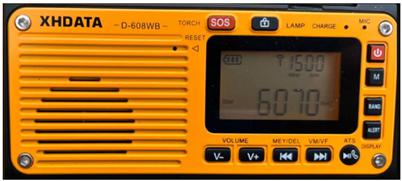
In turbulent times, survival becomes more of a priority than usual. What could be more natural than building a device that is as compact as possible—one that helps and supports us in such a situation of need? A “survival radio”—that’s not really a brand-new idea. However, the D-608 WB from the Chinese company XHData still deserves to be examined in detail for several reasons. Compared to what is currently available on the market in this category, this little all-rounder from southern China stands out clearly, particularly in terms of its ease of use, functional versatility, and impressive reception performance.
As we all know, there’s no accounting for taste. I really like the D-608 WB with its dimensions of 14 x 6 x 3 cm. Bright orange is definitely a signal color: eye-catching and quick to grab when needed. The user manual is clear and easy to understand. Unfortunately, it’s currently only available in English. That’s why I’m now providing a German-language user manual here.
In the following, we’ll take a look at the individual features that give the “Survival Radio” its name, but we’ll also include a detailed test of the various reception options.
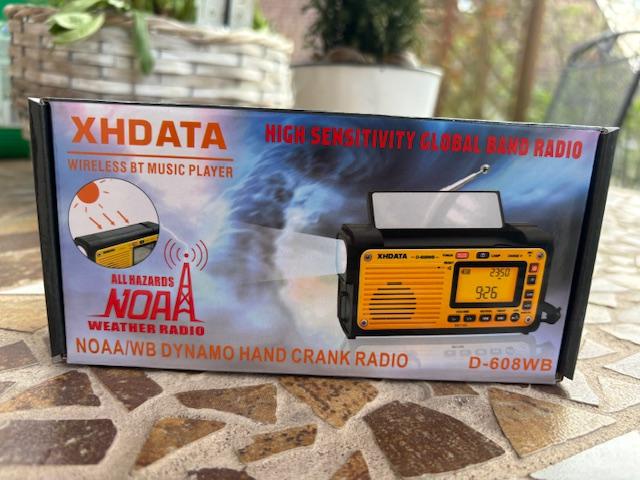
This is how the radio is delivered
Survival Guide
In an emergency, the device’s ability to operate independently of the power grid is of the utmost importance. The XHData D-608 WB is equipped with a powerful, rechargeable battery (18650 3.7V). Before using the device for the first time, it is recommended that you fully charge it. The D-608 WB offers various charging options. The fastest and most effective way to fully charge the battery is definitely using a standard household outlet. A charging cable is included. A power adapter, such as the one required for a conventional cell phone, is not included and should be purchased separately if not already available. However, charging via a PC’s USB port is also possible—the included cable is sufficient for this. In good weather, you can simply place the radio in the sun. A built-in solar cell on the top of the device then charges the battery. Just in case, there is also a hand crank on the back of the receiver that can be used to boost charging power in an emergency. The option to charge the radio via the sun, however, is just as tedious as the hand-crank method. Both options are likely to be used only in emergencies. The hand crank is very practical, though, because when unfolded, it can also be used as a stand to tilt the radio into a DXer-friendly angle.
Light is particularly important during a power outage. The D-608 WB is not just a radio, but also serves as an extremely powerful flashlight. The brightness can be adjusted in three stages as needed: from moderate illumination to very bright light. This is useful in and of itself because the flashlight setting can significantly affect battery consumption. The reading light, located beneath the fold-out solar panel, also has three brightness levels. The reading light can be set bright enough to read a newspaper or a book without straining your eyes too much.
An alarm tone is also among the survival features. The tone is loud enough to effectively scare off burglars. Its special functions related to NOAA weather alerts will be discussed in a later chapter.
Finally, it should be mentioned that XHData naturally included a clock and an alarm when developing this all-purpose device. The device’s battery management is also quite good, so the constant time display has only a minimal effect on the overall runtime.
Operation & Antennas
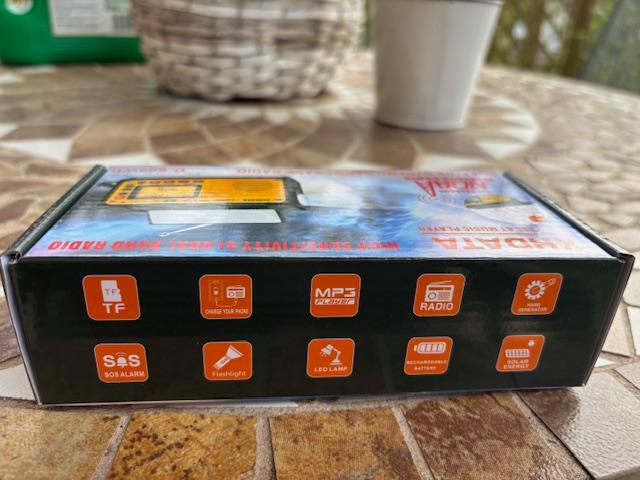
The XHData D 608 WB has it all
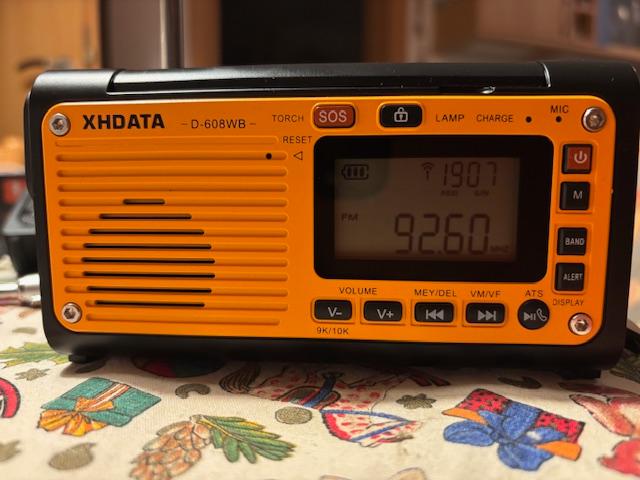
There is a telescoping rod for FM and shortwave reception, and a built-in ferrite antenna for medium wave. A dipole antenna can be connected to the telescoping rod, which further improves reception, especially in the shortwave range. Unfortunately, there is no jack for connecting an external antenna—which would be particularly nice for medium and shortwave reception. There is no longwave, but there is continuous AM reception from 522 kHz to 29,999 kHz. When the radio is turned off, you can easily switch back and forth between the American 10K and 9K grids in the medium-wave range. The “BAND” button is used to select the respective frequency band. There is a special feature in the shortwave range: When it is turned on, you can activate the selection of the desired shortwave band by pressing and holding the “BAND” button—and then select it using the rotary knob.
In addition, stations that you listen to regularly and enjoy can also be saved—both in the AM and FM ranges. There are 100 preset slots available for FM and AM, and as many as 300 for shortwave.
A particularly nice touch is a small card that summarizes the basic functions of the D-608 WB on both the front and back, showing how they work when the radio is both on and off.
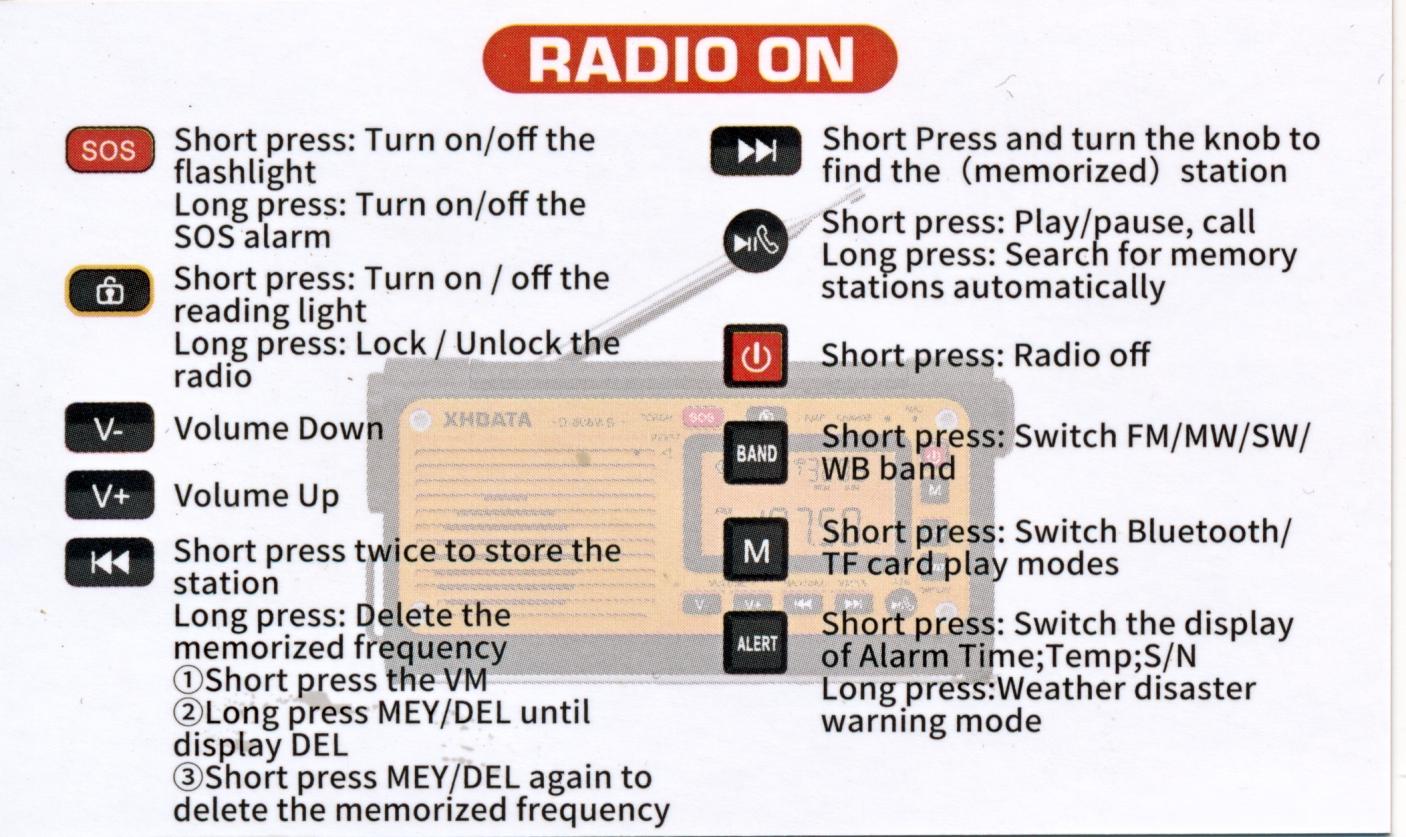
Basic Functions - Front of the Card
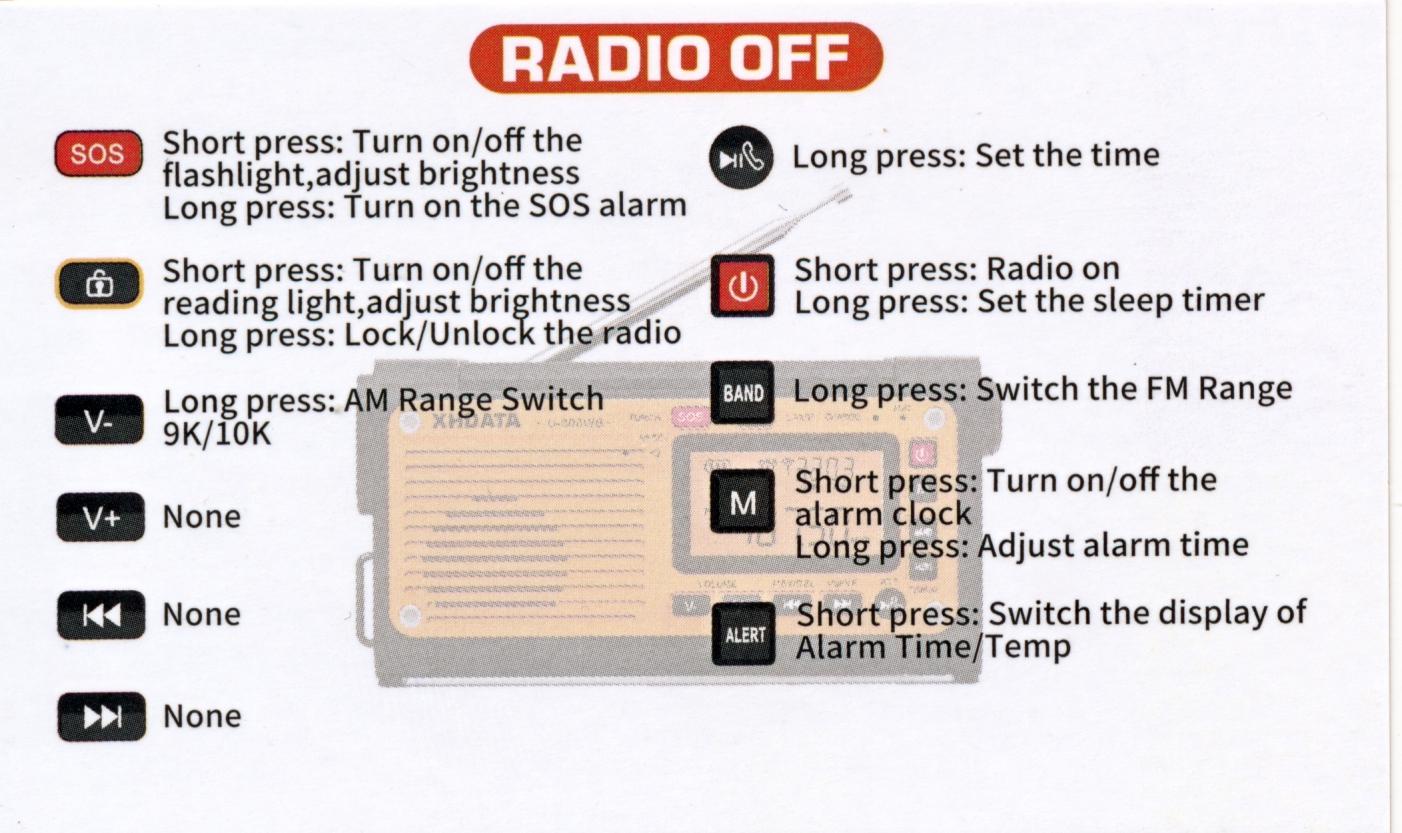
Basic Functions - Back of the Card
FM
Anyone familiar with survival radios from years past will likely be surprised by the reception performance of the XHData D-608 WB. Whereas in the past, only strong local stations could be heard with reasonable clarity, the device now picks up even weaker signals without interference and can certainly hold its own against other, significantly more expensive radios.
For my tests and comparisons, I once again used the Grundig Satellit 700, the Sony ICF 7600 GR, and the small Deepelec DP-666—which has very strong FM reception—as reference units. The high-performance Qodosen DX-286 also served as a test subject. The reception performance of the XHData D-608 WB was nearly on par with both the Deepelec and the Qodosen, and in all other cases even far superior. Matching or even surpassing the DP-666 and the DX-286 on FM is no easy feat anyway. However, neither the Grundig Satellit 700 nor the Sony ICF 7600 GR could keep up with the small XHData on FM.
The sound quality of the stations played back is surprisingly good relative to the size of the device and its speaker. Here’s an example, as in previous device tests: “Deutschlandradio Kultur” broadcasts at 200 watts from Berliner Allee in Freiburg im Breisgau and can be received here in Herbolzheim in northern Breisgau without any problems or interference. The same goes for “uniFM,” which broadcasts at 300 watts from the University Hospital in Freiburg. “Freies Radio Wiesental,” at 500 watts and 60 km away, could also be heard with both the XHData and the two Chinese reference devices. The two classics from Grundig and Sony couldn’t pick up the small stations.
On the XHData D-608 WB, FM covers the frequency range from 64 to 108 MHz. When the unit is off, pressing the “BAND” button allows you to select between 64-108 MHz, 76-108 MHz, 87-108 MHz, and 87.5-108 MHz. The device does not have direct frequency entry, but the ability to store up to 100 stations makes operation much easier.
All in all, the FM tests significantly exceeded my expectations. On a scale of one to ten, where one represents the worst and ten the best, I would give the D-608 WB a nine.
Medium wave
The XHData does not support longwave, but it does support medium wave. When the radio is turned off, you can easily switch back and forth between the 9K and 10K grids (522–1620 kHz or 520–1710 kHz) by simply pressing the “V-” button. As mentioned earlier, the device features a built-in ferrite antenna for medium wave. In many reviews I’ve read so far, the MW reception performance is described as “exceptionally good” or “very good”—which I can certainly confirm after extensive testing.
It is well known that the medium wave band is silent in Germany during the day. After dark, however, it becomes very lively, and stations from all over Europe, as far as North Africa and the Middle East, can be logged. The prerequisite, however, is that the band can be received more or less without interference, which is becoming increasingly difficult due to the many power supplies, LEDs, and other devices, especially in cities. It can definitely be worth trying to listen to the medium wave outdoors, e.g., on a balcony or terrace. Although no external antenna can be connected to the D-608 WB, the reception performance with the built-in equipment is surprisingly good.
Shortwave
The shortwave band covers the entire range from 1,711 kHz to 29,999 kHz. As with the other bands, shortwave frequencies can be adjusted using the rotary knob. By pressing and holding the “BAND” button, you can also select the desired shortwave band. An automatic station search is available, as are 300 preset memory slots. SSB and bandwidth selection are not available in the current version of the device.
Reception performance with the built-in telescopic antenna is very good in the shortwave range. On all shortwave bands, the XHData can certainly compete with the Grundig Satellit 700 or the Sony ICF 7600 GR. Tuning and station search on the selected band are performed in 5 kHz increments, which almost always yields the desired result.
An example: Channel 292 at 6070 kHz can usually be received with virtually no noise during the day—almost as clear as on the Qodosen DX-286 and with even less noise than on the Grundig Satellit 700. Even XEPPM Radio Educacion from Mexico could be heard in the early morning hours—albeit with a relatively weak signal.
All in all, the XHData D-608 WB’s shortwave reception performance is good to very good—truly amazing for a survival radio.
Weather Band / NOAA Alerts
NOAA Weather Radio (NWR) is a public warning and information system operated by the U.S. National Oceanic and Atmospheric Administration (NOAA). It broadcasts 24/7 on 7 fixed VHF frequencies in the 162.400–162.550 MHz range. This includes local weather forecasts, severe weather warnings (tornado, hurricane, flood, blizzard, etc.), Amber Alerts, national emergencies, and more.
This includes automatic weather alerts. A special 1050-Hz tone wakes the radio from standby and triggers an alarm. In such a case, the XHData D-608 WM begins to flash—and the warning tone is activated. The typical range of a NOAA transmitter is 40–70 km. The NOAA system covers nearly the entire U.S. population.
The D-608WB has a dedicated WB/NOAA mode and can receive all 7 available channels—provided you live in the US. Reception in Europe is practically impossible, except perhaps during sporadic-E events—which, however, is extremely unlikely. The NOAA feature on the D-608WB is therefore mainly of interest for travel to the US, moving to the US, or emergency preparedness for America—and cannot practically be tested here in Germany.
Bluetooth & TF Card
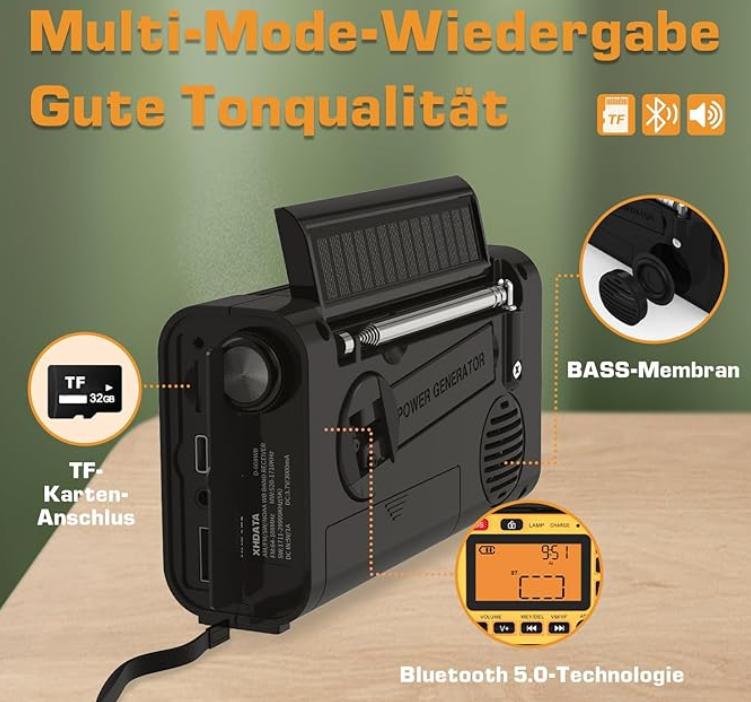
One particularly great feature of the D-608 WB is its Bluetooth functionality. You can pair a smartphone, tablet, PC, or Bluetooth-enabled player to play music, podcasts, YouTube audio, and more—all with a rich, smooth sound. When paired with a smartphone, you can answer calls and speak directly through the radio; the radio is equipped with its own microphone for this purpose. This works flawlessly and is extremely practical in the car, while camping, or during a power outage.
There is also a TF card slot for MicroSD cards up to 32 GB. This allows you to play your own MP3/WMA/WAV/FLAC files. This also makes the D-608 WR a high-quality MP3 player.
Note: A TF card will only work if it is formatted to FAT32. NTFS cards are recognized. This important note is missing from the current documentation.
Conclusion
Small, affordable, with strong reception—and surprisingly versatile. And all for just around 40 euros. The XHData D-608 WB is an extremely versatile survival radio—not just in America. Reception performance is good to very good on all bands, making the device well-suited even for more demanding users as a DX radio and world receiver.
With Bluetooth, SD card functionality, and all the other features described, the radio is hard to beat overall. The XHData is also highly recommended for on-the-go use, for travel, or simply to listen to the news and enjoy your own music. And in an emergency, a survival radio can even save lives.
Sources:
This report: https://www.helmutmatt.de/xhdata_d-608_wb_d.html
German documentation: https://www.helmutmatt.de/xhdata_d_608_wb_manual_d.html
In turbulent times, survival becomes more of a priority than usual. What could be more natural than building a device that is as compact as possible—one that helps and supports us in such a situation of need? A “survival radio”—that’s not really a brand-new idea. However, the D-608 WB from the Chinese company XHData still deserves to be examined in detail for several reasons. Compared to what is currently available on the market in this category, this little all-rounder from southern China stands out clearly, particularly in terms of its ease of use, functional versatility, and impressive reception performance.
As we all know, there’s no accounting for taste. I really like the D-608 WB with its dimensions of 14 x 6 x 3 cm. Bright orange is definitely a signal color: eye-catching and quick to grab when needed. The user manual is clear and easy to understand. Unfortunately, it’s currently only available in English. That’s why I’m now providing a German-language user manual here.
In the following, we’ll take a look at the individual features that give the “Survival Radio” its name, but we’ll also include a detailed test of the various reception options.
This is how the radio is delivered
Survival Guide
In an emergency, the device’s ability to operate independently of the power grid is of the utmost importance. The XHData D-608 WB is equipped with a powerful, rechargeable battery (18650 3.7V). Before using the device for the first time, it is recommended that you fully charge it. The D-608 WB offers various charging options. The fastest and most effective way to fully charge the battery is definitely using a standard household outlet. A charging cable is included. A power adapter, such as the one required for a conventional cell phone, is not included and should be purchased separately if not already available. However, charging via a PC’s USB port is also possible—the included cable is sufficient for this. In good weather, you can simply place the radio in the sun. A built-in solar cell on the top of the device then charges the battery. Just in case, there is also a hand crank on the back of the receiver that can be used to boost charging power in an emergency. The option to charge the radio via the sun, however, is just as tedious as the hand-crank method. Both options are likely to be used only in emergencies. The hand crank is very practical, though, because when unfolded, it can also be used as a stand to tilt the radio into a DXer-friendly angle.
Light is particularly important during a power outage. The D-608 WB is not just a radio, but also serves as an extremely powerful flashlight. The brightness can be adjusted in three stages as needed: from moderate illumination to very bright light. This is useful in and of itself because the flashlight setting can significantly affect battery consumption. The reading light, located beneath the fold-out solar panel, also has three brightness levels. The reading light can be set bright enough to read a newspaper or a book without straining your eyes too much.
An alarm tone is also among the survival features. The tone is loud enough to effectively scare off burglars. Its special functions related to NOAA weather alerts will be discussed in a later chapter.
Finally, it should be mentioned that XHData naturally included a clock and an alarm when developing this all-purpose device. The device’s battery management is also quite good, so the constant time display has only a minimal effect on the overall runtime.
Operation & Antennas
The XHData D 608 WB has it all
There is a telescoping rod for FM and shortwave reception, and a built-in ferrite antenna for medium wave. A dipole antenna can be connected to the telescoping rod, which further improves reception, especially in the shortwave range. Unfortunately, there is no jack for connecting an external antenna—which would be particularly nice for medium and shortwave reception. There is no longwave, but there is continuous AM reception from 522 kHz to 29,999 kHz. When the radio is turned off, you can easily switch back and forth between the American 10K and 9K grids in the medium-wave range. The “BAND” button is used to select the respective frequency band. There is a special feature in the shortwave range: When it is turned on, you can activate the selection of the desired shortwave band by pressing and holding the “BAND” button—and then select it using the rotary knob.
In addition, stations that you listen to regularly and enjoy can also be saved—both in the AM and FM ranges. There are 100 preset slots available for FM and AM, and as many as 300 for shortwave.
A particularly nice touch is a small card that summarizes the basic functions of the D-608 WB on both the front and back, showing how they work when the radio is both on and off.
Basic Functions - Front of the Card
Basic Functions - Back of the Card
FM
Anyone familiar with survival radios from years past will likely be surprised by the reception performance of the XHData D-608 WB. Whereas in the past, only strong local stations could be heard with reasonable clarity, the device now picks up even weaker signals without interference and can certainly hold its own against other, significantly more expensive radios.
For my tests and comparisons, I once again used the Grundig Satellit 700, the Sony ICF 7600 GR, and the small Deepelec DP-666—which has very strong FM reception—as reference units. The high-performance Qodosen DX-286 also served as a test subject. The reception performance of the XHData D-608 WB was nearly on par with both the Deepelec and the Qodosen, and in all other cases even far superior. Matching or even surpassing the DP-666 and the DX-286 on FM is no easy feat anyway. However, neither the Grundig Satellit 700 nor the Sony ICF 7600 GR could keep up with the small XHData on FM.
The sound quality of the stations played back is surprisingly good relative to the size of the device and its speaker. Here’s an example, as in previous device tests: “Deutschlandradio Kultur” broadcasts at 200 watts from Berliner Allee in Freiburg im Breisgau and can be received here in Herbolzheim in northern Breisgau without any problems or interference. The same goes for “uniFM,” which broadcasts at 300 watts from the University Hospital in Freiburg. “Freies Radio Wiesental,” at 500 watts and 60 km away, could also be heard with both the XHData and the two Chinese reference devices. The two classics from Grundig and Sony couldn’t pick up the small stations.
On the XHData D-608 WB, FM covers the frequency range from 64 to 108 MHz. When the unit is off, pressing the “BAND” button allows you to select between 64-108 MHz, 76-108 MHz, 87-108 MHz, and 87.5-108 MHz. The device does not have direct frequency entry, but the ability to store up to 100 stations makes operation much easier.
All in all, the FM tests significantly exceeded my expectations. On a scale of one to ten, where one represents the worst and ten the best, I would give the D-608 WB a nine.
Medium wave
The XHData does not support longwave, but it does support medium wave. When the radio is turned off, you can easily switch back and forth between the 9K and 10K grids (522–1620 kHz or 520–1710 kHz) by simply pressing the “V-” button. As mentioned earlier, the device features a built-in ferrite antenna for medium wave. In many reviews I’ve read so far, the MW reception performance is described as “exceptionally good” or “very good”—which I can certainly confirm after extensive testing.
It is well known that the medium wave band is silent in Germany during the day. After dark, however, it becomes very lively, and stations from all over Europe, as far as North Africa and the Middle East, can be logged. The prerequisite, however, is that the band can be received more or less without interference, which is becoming increasingly difficult due to the many power supplies, LEDs, and other devices, especially in cities. It can definitely be worth trying to listen to the medium wave outdoors, e.g., on a balcony or terrace. Although no external antenna can be connected to the D-608 WB, the reception performance with the built-in equipment is surprisingly good.
Shortwave
The shortwave band covers the entire range from 1,711 kHz to 29,999 kHz. As with the other bands, shortwave frequencies can be adjusted using the rotary knob. By pressing and holding the “BAND” button, you can also select the desired shortwave band. An automatic station search is available, as are 300 preset memory slots. SSB and bandwidth selection are not available in the current version of the device.
Reception performance with the built-in telescopic antenna is very good in the shortwave range. On all shortwave bands, the XHData can certainly compete with the Grundig Satellit 700 or the Sony ICF 7600 GR. Tuning and station search on the selected band are performed in 5 kHz increments, which almost always yields the desired result.
An example: Channel 292 at 6070 kHz can usually be received with virtually no noise during the day—almost as clear as on the Qodosen DX-286 and with even less noise than on the Grundig Satellit 700. Even XEPPM Radio Educacion from Mexico could be heard in the early morning hours—albeit with a relatively weak signal.
All in all, the XHData D-608 WB’s shortwave reception performance is good to very good—truly amazing for a survival radio.
Weather Band / NOAA Alerts
NOAA Weather Radio (NWR) is a public warning and information system operated by the U.S. National Oceanic and Atmospheric Administration (NOAA). It broadcasts 24/7 on 7 fixed VHF frequencies in the 162.400–162.550 MHz range. This includes local weather forecasts, severe weather warnings (tornado, hurricane, flood, blizzard, etc.), Amber Alerts, national emergencies, and more.
This includes automatic weather alerts. A special 1050-Hz tone wakes the radio from standby and triggers an alarm. In such a case, the XHData D-608 WM begins to flash—and the warning tone is activated. The typical range of a NOAA transmitter is 40–70 km. The NOAA system covers nearly the entire U.S. population.
The D-608WB has a dedicated WB/NOAA mode and can receive all 7 available channels—provided you live in the US. Reception in Europe is practically impossible, except perhaps during sporadic-E events—which, however, is extremely unlikely. The NOAA feature on the D-608WB is therefore mainly of interest for travel to the US, moving to the US, or emergency preparedness for America—and cannot practically be tested here in Germany.
Bluetooth & TF Card
One particularly great feature of the D-608 WB is its Bluetooth functionality. You can pair a smartphone, tablet, PC, or Bluetooth-enabled player to play music, podcasts, YouTube audio, and more—all with a rich, smooth sound. When paired with a smartphone, you can answer calls and speak directly through the radio; the radio is equipped with its own microphone for this purpose. This works flawlessly and is extremely practical in the car, while camping, or during a power outage.
There is also a TF card slot for MicroSD cards up to 32 GB. This allows you to play your own MP3/WMA/WAV/FLAC files. This also makes the D-608 WR a high-quality MP3 player.
Note: A TF card will only work if it is formatted to FAT32. NTFS cards are recognized. This important note is missing from the current documentation.
Conclusion
Small, affordable, with strong reception—and surprisingly versatile. And all for just around 40 euros. The XHData D-608 WB is an extremely versatile survival radio—not just in America. Reception performance is good to very good on all bands, making the device well-suited even for more demanding users as a DX radio and world receiver.
With Bluetooth, SD card functionality, and all the other features described, the radio is hard to beat overall. The XHData is also highly recommended for on-the-go use, for travel, or simply to listen to the news and enjoy your own music. And in an emergency, a survival radio can even save lives.
Sources:
This report: https://www.helmutmatt.de/xhdata_d-608_wb_d.html
German documentation: https://www.helmutmatt.de/xhdata_d_608_wb_manual_d.html