Choyong LC90
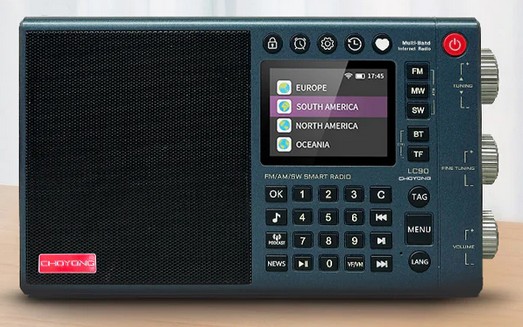
A world receiver with internet radio, Bluetooth, and voice control? It actually exists—although, to my knowledge, there is only one in the world so far. The Choyong company in Shenzhen, Guangdong Province, southern China, has succeeded in bridging the gap. Small, handy, with strong reception and sound – and also brilliant looks: that's the LC90 – currently the top model from Choyong. A meeting of two worlds, you might say. But only at first glance. A love of radio and long-distance reception are the connecting elements – and on closer inspection, they complement each other beautifully. This means you can listen to brilliant Internet radio when there is nothing appealing to be heard on the analog bands. It is also possible to listen to the radio in the traditional way when the Internet is down or, more importantly, when you are struck by wave fever again. On closer inspection, it is rather surprising that it took so long for such a hybrid to finally be developed – one that DXers in particular have been waiting and hoping for for a long time. And the menu is now also available in German.
How can one describe the first impression when unpacking the radio? Elegant design, clear display, largely self-explanatory function keys. However, it is still advisable to study the accompanying (English-language) documentation in detail, especially since the device can do much more than you might think at first glance. To make it easier to get started, I have created a German-language device description.
It weighs just 640 grams, including a rechargeable and replaceable battery. Normally, you press the power button and the radio plays. But with the Choyong LC90, it's different: you have to press the red power button for a full two seconds—which is actually very practical because it makes accidental switching on, e.g., during transport, less likely. The device also has an additional lock mechanism—as well as a timer and alarm clock function.
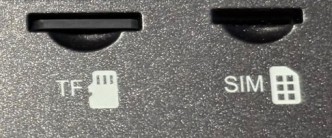
While the analog bands are available as soon as you turn it on, the online features naturally require an internet connection. The button for configuring the device is located at the top center. Available networks are detected automatically – but only by systems that have 2.4 GHz Wi-Fi. 5 GHz is not currently supported. Once you have entered the network key, all reception options are then fully available. While conventional internet radios only have a Wi-Fi function, the Choyong radio also offers the luxurious option of listening to internet stations independently of a local network. There are two slots on the underside for this purpose: With a data SIM card, you can listen to music completely independently of your own network – worldwide – provided that Internet reception is available at the respective location. The second slot is intended for a TF card on which you can store and play your own music. Up to 32 GB are possible. However, it is better to switch off the device before inserting a card.
Internetradio
Once you have turned on the radio, the analog bands (LW, MW, KW, FM) are immediately available—however, for online stations, the device must first connect to the WLAN and WAN, which can take a few seconds. Choyong manages its own database, which provides access to online radio stations. The selection is enormous, with over 45,000 stations available. And if you can't find a particular station, you can easily add it yourself via an online interface. The stations are sorted by continent and country. German stations are assigned to the respective federal states, and public broadcasters have their own section. In addition to the many Internet radio stations, listeners will find an almost limitless number of podcasts. For ease of use, there are “News,” “Music,” and “Podcasts” buttons for finding stations or podcasts. You can also select by tags or language. And that's not all: the LC90 also has voice control. This allows you to “talk” to the radio and simply “call up” the desired station without having to type or fiddle around. “Please search for BBC Radio” or “please play Kontrafunk” – and the stations are searched for and displayed in a list of results, from which you can then select the desired station. To be fair, it should be added that the voice control does not work 100% of the time – often because the spoken word is not always interpreted correctly. Occasionally, it helped if I pronounced the station name in English. The sound quality of the LC90 is amazingly good. However, this also depends on the data rate transmitted by the station you are tuned into.
Bluetooth and TF
If you have paired your radio with a Bluetooth device, such as a cell phone, you can be your own program director and conveniently play music files or YouTube audio. With the additional option of storing and playing music, podcasts, audiobooks, etc. on a TF card, the possibilities offered by the radio are virtually unlimited.
Analog Radio
FM
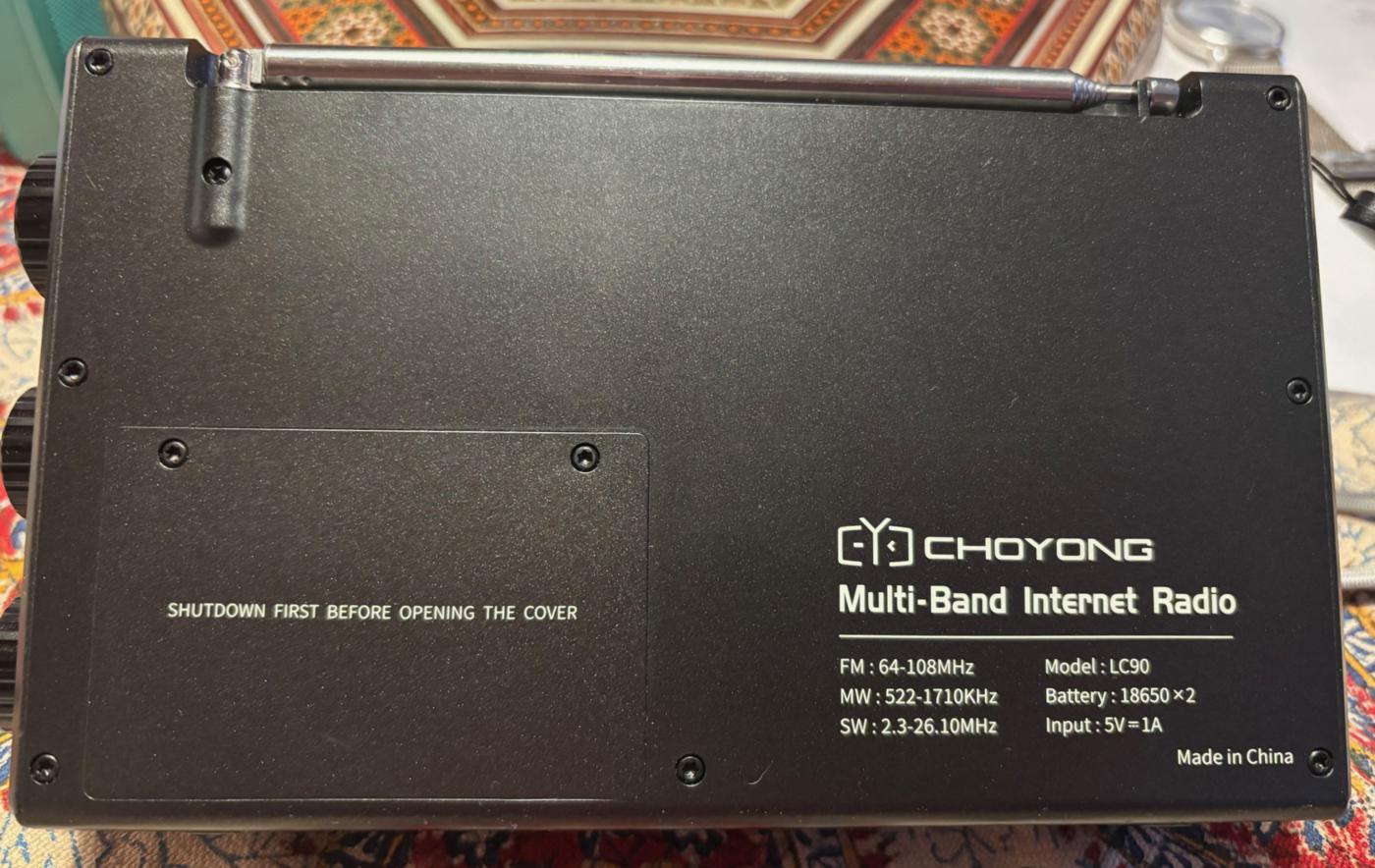
The frequency spectrum for FM ranges from 64 MHz to 108 MHz—adjustable in 10 and 100 KHz increments. It is also possible to enter the frequency directly using the number keys. For my tests and comparisons, I used the Sony ICF 7600 GR and the small Deepelec DP-666, which has very strong FM reception, as reference devices. While the reception performance of the Chinese LC90 is almost on par with the DP-666, the Sony cannot keep up. The sound of the stations played is brilliant. The Choyong is far superior to the two reference devices in this respect. Here's another example: “Deutschlandradio Kultur” broadcasts at 200 watts from Berliner Allee in Freiburg i. Br. and can be received here in Herbolzheim in northern Breisgau without any problems or interference. The same applies to “uniFM,” which broadcasts from the Freiburg University Hospital with 300 watts. “Freies Radio Wiesental,” 500 watts and 60 km away, could also be heard with both the DP-666 and the LC90. The Sony failed to pick up any of the three stations.
Longwave / Mediumwave
The LC90 can also receive long and medium wave signals. The device has a built-in ferrite antenna for this purpose. Unusually, the telescopic antenna can also be used, which significantly improves reception. Nevertheless, it must be said that medium wave and long wave are the only real weak points. It is very difficult to receive small and micro transmitters such as the museum radio from Bad Ischl. In its defense, however, it should be added that the radio has a socket for an external antenna, which is particularly advantageous in the AM range. When I connect the device to my Wellbrook Loop, stations that were previously inaudible suddenly become audible—and a noisy “Channel 292” can be heard wonderfully clearly in this way. It should also be mentioned that here in Central Europe, there is only anything to hear on medium wave after dark anyway. The LC90's medium wave spectrum ranges from 522 to 1710 KHz and can be adjusted in increments of 1, 9, or 10 KHz. Another nice feature is the variable bandwidth of the stations, which is also available for the other analog bands.
Shortwave
The shortwave range covers everything from 2,300 kHz to 29,999 kHz. Just like the other bands, the shortwave can be tuned using the rotary knobs or by entering the frequency directly. SSB reception is also available for both the upper and lower ranges, which is sure to please amateur radio enthusiasts. The adjustable bandwidth expands the possibilities even further. The reception performance with the built-in telescopic antenna is very decent and quite on par with the Grundig Satellit 700 or the Sony ICF 7600 GR. However, connecting a good external antenna also works wonders on shortwave.
Conclusion
Compared to its few weak points, the LC90 clearly has more strengths. I myself have been waiting for a radio like this for a long time and am very pleased that Choyong had the courage to build something like this. For such a high-quality device, I think the current price of around 250 euros is quite reasonable. However, Choyong should also consider DAB radio reception in the future, especially since there are already countries where FM radio is no longer available. As a Chinese manufacturer, DRM, i.e., digital medium and shortwave, should not be overlooked either, given that both China and India want to make increasing use of this technology.
A world receiver with internet radio, Bluetooth, and voice control? It actually exists—although, to my knowledge, there is only one in the world so far. The Choyong company in Shenzhen, Guangdong Province, southern China, has succeeded in bridging the gap. Small, handy, with strong reception and sound – and also brilliant looks: that's the LC90 – currently the top model from Choyong. A meeting of two worlds, you might say. But only at first glance. A love of radio and long-distance reception are the connecting elements – and on closer inspection, they complement each other beautifully. This means you can listen to brilliant Internet radio when there is nothing appealing to be heard on the analog bands. It is also possible to listen to the radio in the traditional way when the Internet is down or, more importantly, when you are struck by wave fever again. On closer inspection, it is rather surprising that it took so long for such a hybrid to finally be developed – one that DXers in particular have been waiting and hoping for for a long time. And the menu is now also available in German.
How can one describe the first impression when unpacking the radio? Elegant design, clear display, largely self-explanatory function keys. However, it is still advisable to study the accompanying (English-language) documentation in detail, especially since the device can do much more than you might think at first glance. To make it easier to get started, I have created a German-language device description.
It weighs just 640 grams, including a rechargeable and replaceable battery. Normally, you press the power button and the radio plays. But with the Choyong LC90, it's different: you have to press the red power button for a full two seconds—which is actually very practical because it makes accidental switching on, e.g., during transport, less likely. The device also has an additional lock mechanism—as well as a timer and alarm clock function.
While the analog bands are available as soon as you turn it on, the online features naturally require an internet connection. The button for configuring the device is located at the top center. Available networks are detected automatically – but only by systems that have 2.4 GHz Wi-Fi. 5 GHz is not currently supported. Once you have entered the network key, all reception options are then fully available. While conventional internet radios only have a Wi-Fi function, the Choyong radio also offers the luxurious option of listening to internet stations independently of a local network. There are two slots on the underside for this purpose: With a data SIM card, you can listen to music completely independently of your own network – worldwide – provided that Internet reception is available at the respective location. The second slot is intended for a TF card on which you can store and play your own music. Up to 32 GB are possible. However, it is better to switch off the device before inserting a card.
Internetradio
Once you have turned on the radio, the analog bands (LW, MW, KW, FM) are immediately available—however, for online stations, the device must first connect to the WLAN and WAN, which can take a few seconds. Choyong manages its own database, which provides access to online radio stations. The selection is enormous, with over 45,000 stations available. And if you can't find a particular station, you can easily add it yourself via an online interface. The stations are sorted by continent and country. German stations are assigned to the respective federal states, and public broadcasters have their own section. In addition to the many Internet radio stations, listeners will find an almost limitless number of podcasts. For ease of use, there are “News,” “Music,” and “Podcasts” buttons for finding stations or podcasts. You can also select by tags or language. And that's not all: the LC90 also has voice control. This allows you to “talk” to the radio and simply “call up” the desired station without having to type or fiddle around. “Please search for BBC Radio” or “please play Kontrafunk” – and the stations are searched for and displayed in a list of results, from which you can then select the desired station. To be fair, it should be added that the voice control does not work 100% of the time – often because the spoken word is not always interpreted correctly. Occasionally, it helped if I pronounced the station name in English. The sound quality of the LC90 is amazingly good. However, this also depends on the data rate transmitted by the station you are tuned into.
Bluetooth and TF
If you have paired your radio with a Bluetooth device, such as a cell phone, you can be your own program director and conveniently play music files or YouTube audio. With the additional option of storing and playing music, podcasts, audiobooks, etc. on a TF card, the possibilities offered by the radio are virtually unlimited.
Analog Radio
FM
The frequency spectrum for FM ranges from 64 MHz to 108 MHz—adjustable in 10 and 100 KHz increments. It is also possible to enter the frequency directly using the number keys. For my tests and comparisons, I used the Sony ICF 7600 GR and the small Deepelec DP-666, which has very strong FM reception, as reference devices. While the reception performance of the Chinese LC90 is almost on par with the DP-666, the Sony cannot keep up. The sound of the stations played is brilliant. The Choyong is far superior to the two reference devices in this respect. Here's another example: “Deutschlandradio Kultur” broadcasts at 200 watts from Berliner Allee in Freiburg i. Br. and can be received here in Herbolzheim in northern Breisgau without any problems or interference. The same applies to “uniFM,” which broadcasts from the Freiburg University Hospital with 300 watts. “Freies Radio Wiesental,” 500 watts and 60 km away, could also be heard with both the DP-666 and the LC90. The Sony failed to pick up any of the three stations.
Longwave / Mediumwave
The LC90 can also receive long and medium wave signals. The device has a built-in ferrite antenna for this purpose. Unusually, the telescopic antenna can also be used, which significantly improves reception. Nevertheless, it must be said that medium wave and long wave are the only real weak points. It is very difficult to receive small and micro transmitters such as the museum radio from Bad Ischl. In its defense, however, it should be added that the radio has a socket for an external antenna, which is particularly advantageous in the AM range. When I connect the device to my Wellbrook Loop, stations that were previously inaudible suddenly become audible—and a noisy “Channel 292” can be heard wonderfully clearly in this way. It should also be mentioned that here in Central Europe, there is only anything to hear on medium wave after dark anyway. The LC90's medium wave spectrum ranges from 522 to 1710 KHz and can be adjusted in increments of 1, 9, or 10 KHz. Another nice feature is the variable bandwidth of the stations, which is also available for the other analog bands.
Shortwave
The shortwave range covers everything from 2,300 kHz to 29,999 kHz. Just like the other bands, the shortwave can be tuned using the rotary knobs or by entering the frequency directly. SSB reception is also available for both the upper and lower ranges, which is sure to please amateur radio enthusiasts. The adjustable bandwidth expands the possibilities even further. The reception performance with the built-in telescopic antenna is very decent and quite on par with the Grundig Satellit 700 or the Sony ICF 7600 GR. However, connecting a good external antenna also works wonders on shortwave.
Conclusion
Compared to its few weak points, the LC90 clearly has more strengths. I myself have been waiting for a radio like this for a long time and am very pleased that Choyong had the courage to build something like this. For such a high-quality device, I think the current price of around 250 euros is quite reasonable. However, Choyong should also consider DAB radio reception in the future, especially since there are already countries where FM radio is no longer available. As a Chinese manufacturer, DRM, i.e., digital medium and shortwave, should not be overlooked either, given that both China and India want to make increasing use of this technology.